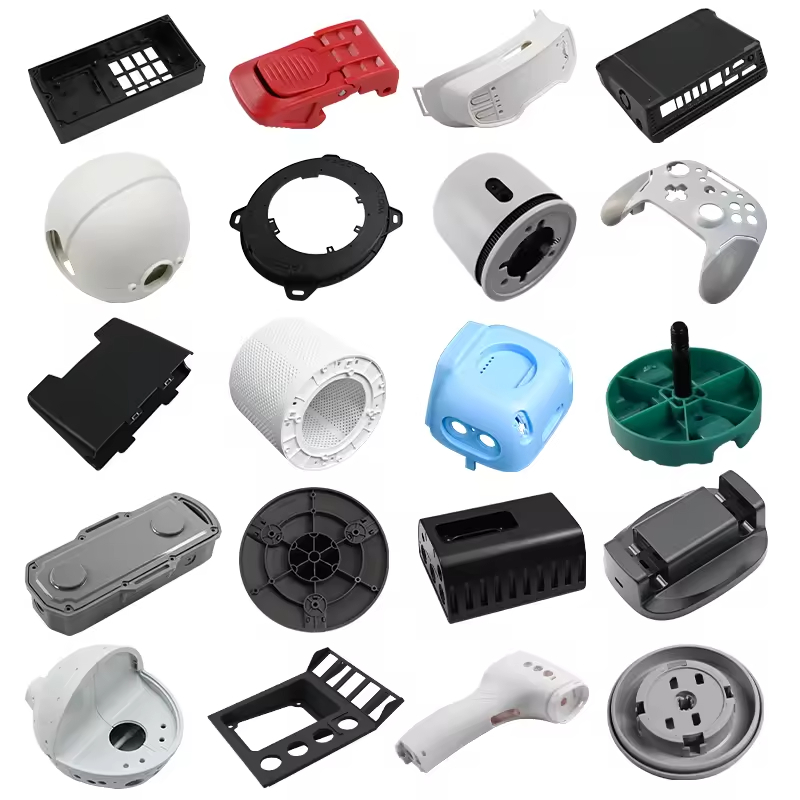
Стоимость литья под давлением: инженерный подход
Стоимость литья под давлением складывается из затрат на изготовление пресс-форм, текущего производства, дополнительных операций, обеспечения качества и логистики. Простая пресс-форма может стоить всего несколько тысяч долларов, в то время как закаленная многогнездная производственная пресс-форма со слайдерами, системой горячеканального литья, текстурой и валидацией может стоить десятки тысяч долларов и более. Поэтому правильный вопрос звучит не так: “Какое предложение по пресс-форме самое дешевое?”, а так: “Какое предложение обеспечит наименьшую контролируемую стоимость при требуемом объеме производства?”
Для проведения достоверного сравнения необходимо сначала привести все ценовые предложения к единому стандарту, учитывая одинаковые технические характеристики пресс-формы, годовой объем производства, марку пластмассы, предполагаемую продолжительность цикла, план контроля качества, требования к упаковке и условия поставки. Если какие-либо из этих параметров различаются, итоговые суммы ценовых предложений не поддаются прямому сравнению.
| Вопрос для принятия решения | Фактор, влияющий на затраты: требует подтверждения | Почему это влияет на котировку |
|---|---|---|
| Сколько деталей требуется в год? | Количество полостей, сталь для пресс-форм, автоматизация, время цикла | Годовой спрос определяет, что будет дешевле в целом: более недорогая одногнездная форма или производственная форма с более высокой производительностью. |
| Какой срок службы должна обеспечить форма? | Марка стали, твердость, сменные вставки, защита от износа | Прототип станка и станок, рассчитанный на миллион циклов, не должны оцениваться и стоить как равноценное оборудование. |
| Какие размеры являются критическими? | Точность обработки, выравнивание пресс-форм, технологическая способность, контроль качества | Жесткие допуски могут привести к увеличению затрат на изготовление инструментов, отбор проб, метрологию и контроль технологического процесса. |
| Что входит в комплект поставки детали? | Удаление литниковых каналов, установка вставок, сборка, маркировка, контроль качества, упаковка | Низкая стоимость литой детали может означать, что в процесс не включены операции, необходимые для получения готового к отгрузке компонента. |
Введение: Почему стоимость литья под давлением может так сильно варьироваться
Предложения от двух заводов $3,800 и $11,200 для одной и той же формы. В обоих случаях указано: “Сталь P20, двухгнездная”. Чем объясняется такой трехкратный разброс цен? Причиной редко бывает нечестность — чаще всего это различия в том, что фактически включает в себя предложение: сертификация стали, закалка полостей, глубина текстуры, количество выталкивающих штифтов, схема охлаждения, условия пожизненной гарантии, запасные наборы вставок и операции по последующей обработке, которые один поставщик включает в пакет, а другой выставляет в счёт отдельно.
В данном руководстве затраты на литье под давлением разбиты на модель с тремя ведрами, объясняет, чем обусловлены отдельные статьи расходов, предлагает 10 вопросов, которые позволяют мгновенно отделить серьёзных поставщиков от тех, кто только тратит ваше время, а также приводит ориентировочные диапазоны цен, чтобы вы могли определить, является ли предложение конкурентоспособным, ещё до начала переговоров.

Модель затрат «три корзины»
Любой проект по литью под давлением, независимо от того, заказываете ли вы 5 000 или 500 000 единиц, можно разбить ровно на три категории затрат. Рассчитывать их по отдельности — и отказываться от предложений с фиксированной суммой — является самой эффективной тактикой контроля затрат.
| Ведро | Что входит в программу | Типичная доля в общей стоимости | Одноразовый или периодический |
|---|---|---|---|
| Группа 1: Оснастка для литья | Основание пресс-формы, обработка полости/сердечника, система горячеканального литья, выталкивание, охлаждающие каналы, сборка, пробное производство, приемочный контроль первого изделия | 60–85 % от расходов первого года (небольшой объем) или 10–25 % (большой объем) | Единовременные затраты (амортизируются в течение срока реализации проекта) |
| Группа 2: Цена за единицу детали | Сырье, ставка за машино-час, затраты на оплату труда операторов, электроэнергия, накладные расходы, норма прибыли | 15–40 % от расходов первого года (небольшой объем) или 75–90 % (большой объем) | Периодическая оплата за каждый снимок |
| Группа 3: Вторичные операции | Обрезка/удаление литников, ультразвуковая сварка, тампонная печать, горячее тиснение, установка вставок, сборка, упаковка | 5–25 % от общей стоимости детали (значительно варьируется в зависимости от сложности детали) | Периодическая стоимость одной детали |
Основной вывод: Поставщик, предлагающий низкую стоимость изготовления пресс-форм, может компенсировать это завышенной ценой за единицу продукции. Всегда требуйте, чтобы в каждом предложении позиции «Группа 1» и «Группа 2» указывались отдельными строками. Если поставщик отказывается выделить их отдельно, рассматривайте это как тревожный сигнал.
Оборудование для литья под давлением: что определяет цену
Выбор марки стали
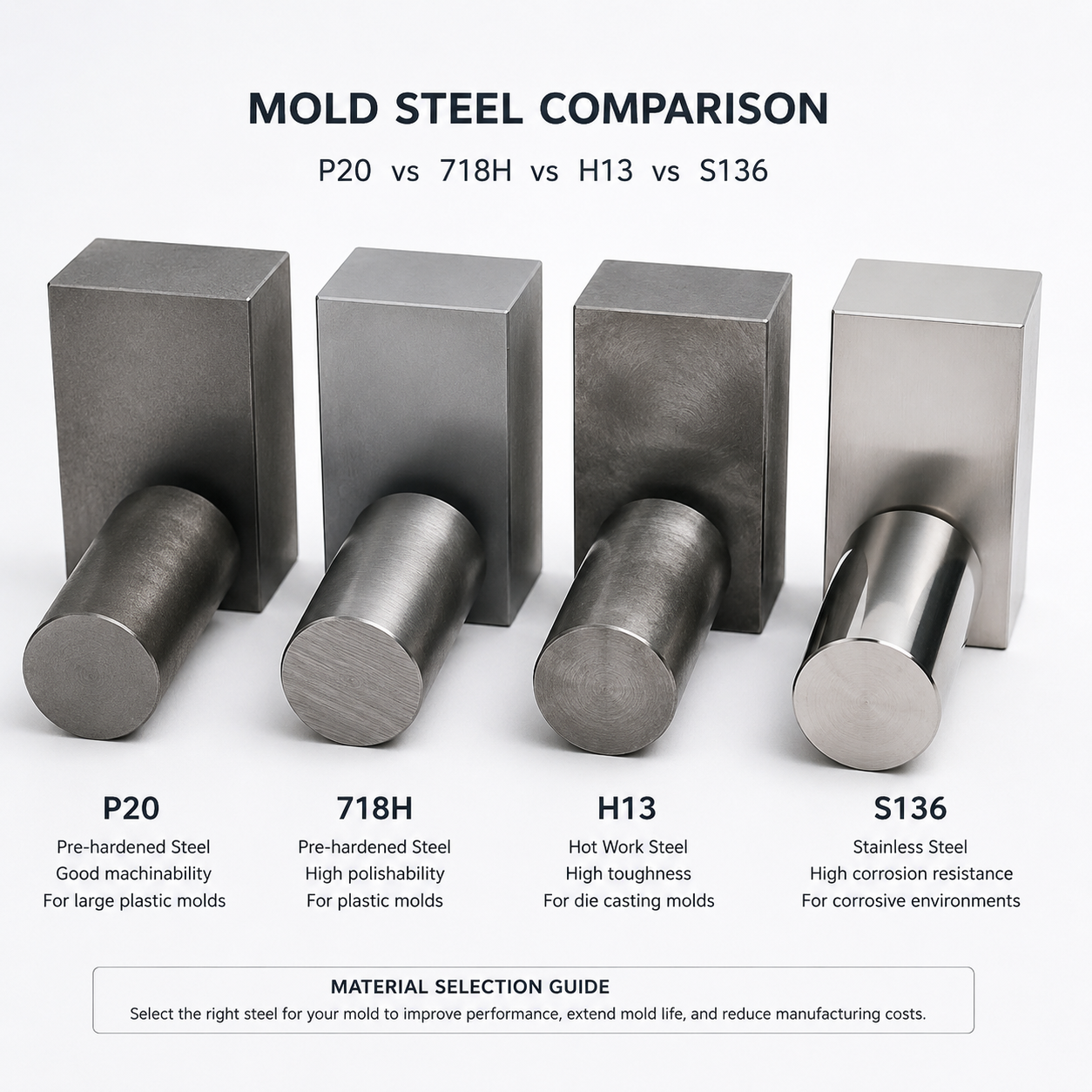
Самым значительным фактором, влияющим на стоимость любой пресс-формы, является марка стали, выбранная для вставок полости и сердечника. Для прототипных пресс-форм (менее 10 000 циклов) может быть достаточно алюминия или стали P20. Для серийных пресс-форм, рассчитанных на 500 000 и более циклов, необходимо использовать закаленную сталь H13 или S136, которая изначально обходится в 3–5 раз дороже.
| Марка стали | Твёрдость (HRC) | Срок службы (количество выстрелов) | Лучшее для | Индекс относительной стоимости |
|---|---|---|---|---|
| P20 (предварительно закаленная) | 28–32 | 50,000–200,000 | Универсальные неабразивные полимеры (ABS, PP, PE) | 1,0x (исходный уровень) |
| 718H (предварительно закаленная, с улучшенной полировкой) | 33–38 | 100,000–300,000 | Косметические детали с высоким блеском, линзы, прозрачные детали | 1.3–1.6x |
| H13 (для горячей обработки, прокаленная) | 48–52 | 500,000–1,000,000+ | Смолы, армированные стекловолокном; области применения, требующие высокой износостойкости; крупносерийное производство | 2.0–3.5x |
| Нержавеющая сталь S136 / 420 (закаленная) | 48–54 | 300,000–800,000 | Медицинские изделия, материалы, контактирующие с пищевыми продуктами, коррозионно-активные смолы (ПВХ, ПОМ) | 2.5–4.0x |
Практическое правило: При объемах производства менее 50 000 единиц материал P20 почти всегда является правильным выбором, за исключением случаев, когда речь идет о стеклонаполненном нейлоне или жестком ПВХ. Не позволяйте поставщику «навязать» вам материал H13 для заказа объемом 20 000 единиц — это просто не окупится.
Экономика производства с одной и несколькими полостями
Добавление полостей — это классический компромисс: более высокие первоначальные затраты на изготовление пресс-формы в обмен на более низкую удельную стоимость детали. Эта зависимость не является линейной. Одногнездная форма стоит X; двухгнездная форма стоит примерно в 1,6–1,8 раза больше (а не в 2 раза), поскольку основа формы, охлаждающий коллектор и коллектор горячеканальной системы являются общими. При количестве гнезд свыше 8 сложность резко возрастает из-за проблем с балансом заполнения и равномерностью охлаждения.
| Полости | Коэффициент затрат на инструмент по сравнению с одногнездовой формой | Влияние времени цикла | Оптимально подходит для (годовой объем) |
|---|---|---|---|
| 1 | 1.0x | Исходные данные | 1–10,000 |
| 2 | 1.6–1.8x | Количество деталей за цикл удваивается; продолжительность цикла остается примерно такой же | 10,000–50,000 |
| 4 | 2.5–3.2x | 4-кратный выход; немного более длительный цикл для обеспечения баланса охлаждения | 50,000–250,000 |
| 8 | 4.0–5.5x | Увеличение производительности в 8 раз; сложность систем охлаждения и управления затворами увеличивает длительность цикла на 10–15 % | 250,000–1,000,000 |
| 16+ | 6.0–9.0x | Требуется сложная балансировка бегунов; не все геометрии совместимы | 1,000,000+ |
Факторы сложности, приводящие к увеличению стоимости изготовления пресс-форм
Помимо стали и кавитации, стоимость пресс-формы значительно увеличивают несколько конструктивных особенностей:
- Боковые действия / слайды: Каждый подрез, требующий механизма бокового действия, увеличивает стоимость инструмента на 800–3 000 долларов (по китайским ценам). Деталь с 4 механизмами бокового действия может удвоить стоимость основания пресс-формы.
- Сердечники подъемников: Внутренние подрезы, выполняемые с помощью подъемников, как правило, увеличивают стоимость на 400–1 200 долларов за каждый подъемник.
- Резьбовые сердечники (отвинчивание): Для вращающихся резьбовых сердечников требуются гидравлические или зубчатые приводы. Добавьте 2 000–6 000 долларов за каждый элемент с резьбой.
- Жесткие допуски: Допуски в пределах ±0,05 мм по любому размеру требуют прецизионной электроэрозионной глубокой резки и более точного выравнивания пресс-формы — это увеличивает стоимость обработки полости на 20–40 %.
- Глубокая полировка: Для зеркальной полировки по стандартам SPI A-1–A-3 требуется сталь марки 718H или S136, а также 40–80 часов ручной полировки — стоимость увеличивается на 1 000–4 000 долларов в зависимости от площади поверхности.
- Текстура (стандарты VDI/MT): Химическое травление или лазерная текстуризация увеличивают стоимость на 300–2 000 долларов за каждую сторону полости в зависимости от глубины и сложности рисунка.
- Конформное охлаждение: Охлаждающие вставки, напечатанные на 3D-принтере и повторяющие сложные контуры детали, могут сократить время цикла на 20–40 %, но при этом увеличат стоимость пресс-формы на 1 500–5 000 долларов. Оцените окупаемость с учетом объема производства.

Разбивка цены за единицу по частям
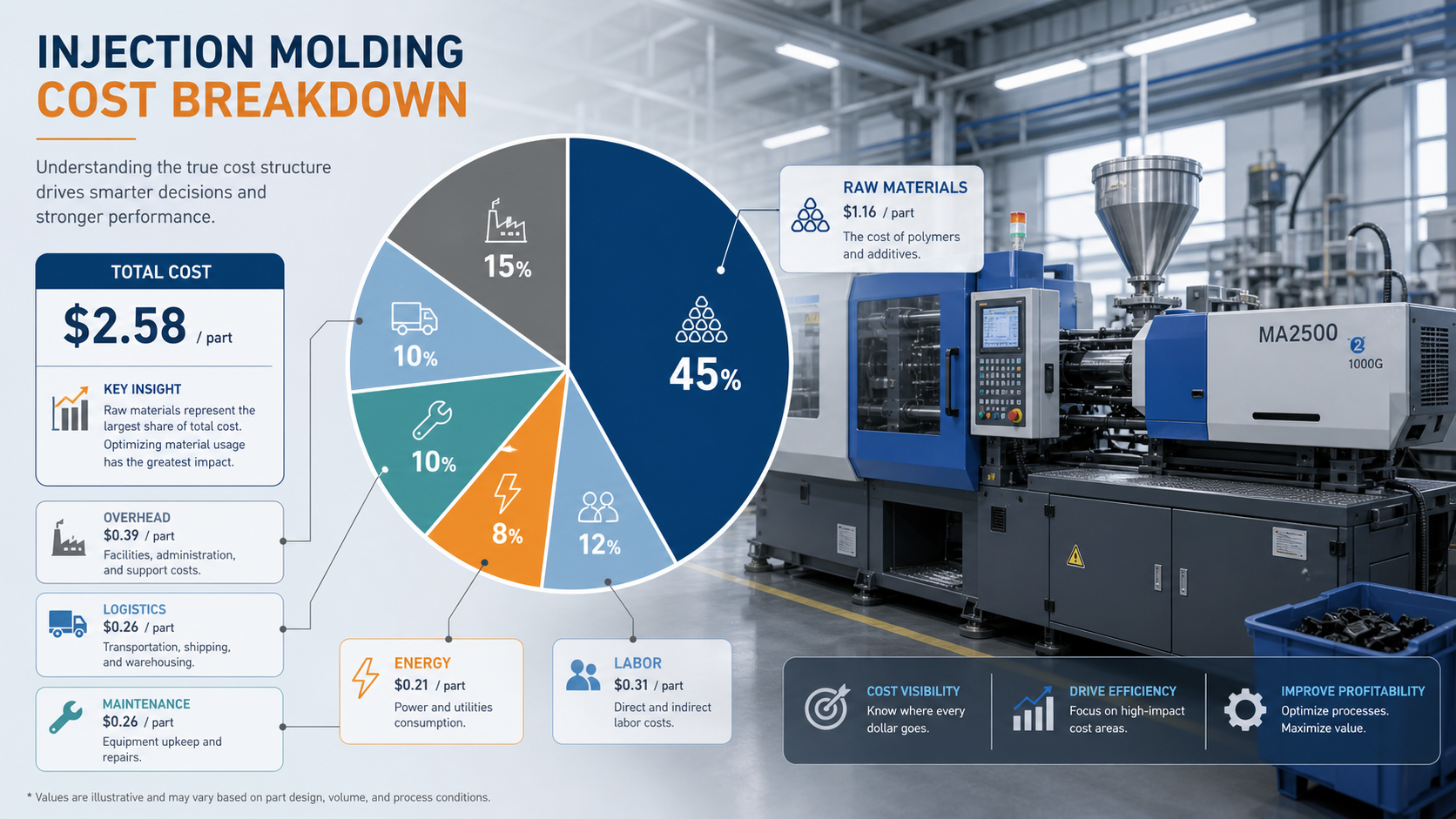
После изготовления пресс-формы периодические затраты на каждый цикл определяются тремя составляющими: стоимостью материала, временем работы станка и накладными расходами.
Стоимость материалов (40–60 % от цены за единицу)
Стоимость материала определяет цену детали. Для стандартных пластиков (PP, PE, PS) стоимость материала составляет 1,00–2,50 долл. США/кг, что соответствует 0,02–0,15 долл. США на одну деталь. Для инженерных пластиков (PA6 с 30 % стекловолокна, PBT, POM) стоимость составляет 3,00–6,00 долларов за кг. Для высокотемпературных или специальных пластиков (PEEK, PPS, LCP) стоимость одного только материала может достигать 40–80 долларов за кг.
Практика поставщика, на которую стоит обратить внимание: Многие китайские поставщики добавляют к стоимости сырья 8–15 % в качестве наценки за “обработку материалов”. Некоторые указывают в предложении полную цену по прейскуранту, хотя сами закупают сырье по сниженным оптовым ценам и присваивают себе разницу. Уточняйте, указывается ли стоимость материала по себестоимости или по принципу «себестоимость плюс наценка», и требуйте указывать марку и сорт смолы в каждой строке коммерческого предложения.
Ставка за час работы оборудования (15–50 долл. США/час в Китае, 60–180 долл. США/час на западных рынках)
Ставка за машино-час включает амортизацию пресса, расходы на электроэнергию, воду, заработную плату оператора и основные накладные расходы. Ставки варьируются в зависимости от тоннажа пресса:
| Усилие зажима (тонн) | Типичная ставка — Китай (долл. США/час) | Стандартная ставка — Северная Америка/Европа (долл. США/час) |
|---|---|---|
| 80–120T | $4–10 | $35–55 |
| 160–250T | $8–18 | $45–75 |
| 300–500T | $15–30 | $60–120 |
| 650–1,200T | $25–50 | $90–180 |
Machine rates below $4/hr in China should trigger skepticism — at that level, the supplier is either losing money on the press or compensating through inflated material pricing.
Cycle Time and Its Leverage
A part that cycles in 18 seconds costs roughly half as much per unit as the same part cycling in 36 seconds (all else equal). Cycle time is the product of injection time, cooling time (typically 50–70% of total cycle), mold opening/closing, and part ejection. Optimizing cooling layout in the mold design phase — running larger water lines, using bubblers or baffles for deep cores, or specifying conformal cooling — can reduce cycle time by 20–40% and deliver a 6-month payback through reduced part unit prices.
Ten Questions to Ask Before You Accept Any Quote
These questions are designed to expose gaps in the quote — things the supplier left out intentionally or simply did not think of. A supplier that answers all ten comfortably is worth a deeper conversation. One that dodges three or more should be dropped immediately.
- “Is the steel grade certified? Can you provide the mill certificate with the mold?” Many suppliers say “P20” and deliver a lower-grade equivalent (e.g., 2738 or 2311 with reduced hardness). Require the mill certificate.
- “Does the tooling price include a mold-flow analysis, or is that billed separately?” Mold-flow analysis (Autodesk Moldflow or Moldex3D) typically costs $400–1,200 and is often excluded. Without it, you risk gate placement and warpage problems discovered only at trial.
- “How many spare ejector pins, spare core pins, and spare heater bands are included?” Standard practice is one spare ejector pin of each size, one spare core pin per cavity, and one spare heater band per zone. If zero spares are included, add $200–600 to initial budget.
- “What texture depth and standard are included, and is there a per-side charge?” Texture (e.g., VDI 24, MT-11010) costs $200–800 per side. Confirm it is included — not billed separately after mold acceptance.
- “Is PPAP (Production Part Approval Process) included, and to what level — Level 1, 2, or 3?” A full PPAP Level 3 submission (dimensional report, material cert, capability study, control plan) costs $800–2,500 and is rarely included in the base tooling price.
- “Is the mold warranty for lifetime or a fixed number of shots? What is covered — just the cavity/core, or also the hot-runner system and ejector mechanism?” Most suppliers warrant against manufacturing defects for 100,000–200,000 shots, but many exclude hot-runner components (which carry their own manufacturer warranty). Get the exclusion list in writing.
- “What is the maintenance interval, and do you provide a recommended spare-parts list with lead times?” Every mold needs periodic preventative maintenance — cleaning, lubrication, sharpening. A supplier without a documented PM plan has not thought about your mold beyond delivery.
- “Does the part unit price include deflashing, de-gating, and packaging? If not, what are the secondary operation adders?” Secondary operations are the most commonly omitted costs in injection molding quotes. A part that arrives still attached to the runner is not a finished part.
- “What is the payment structure — and what milestone gates release each payment?” Standard terms are 30–50% deposit with mold design sign-off, 30–40% at first trial (T1), and 15–20% at PPAP approval or shipment. Avoid 100% upfront, and ensure the final 10–15% is held until at least T1 samples are approved.
- “Can you provide three references for projects with similar part size, material, and volume within the last 12 months?” If a supplier hesitates here, they may not have relevant experience. A reference check takes 15 minutes and can save tens of thousands of dollars in failed tooling.
Quick Reference: Cost Ranges by Part Complexity
The table below provides rough order-of-magnitude ranges for mold tooling and unit price, based on part complexity for parts weighing 20–200 grams in commodity-grade P20 steel, produced in China. Add 25–50% for Western European or North American tool shops. Add 30–80% for H13 or S136 steel.
| Part Complexity | Example Parts | Mold Tooling (Single Cavity, P20, China) | Unit Price Range (Material + Machine) | Typical Lead Time |
|---|---|---|---|---|
| Simple (no side actions, open-close only) | Flat caps, spacers, simple bushings, nameplates | $1,800–4,500 | $0.08–0.35 | 4–6 weeks |
| Умеренный (1–2 side actions, basic ribs) | Enclosures, brackets, housings, connectors | $4,500–12,000 | $0.25–0.85 | 6–9 weeks |
| Complex (3+ side actions, threads, tight tolerances) | Automotive interior trim, medical device housings, multi-port manifolds | $12,000–35,000 | $0.60–2.50 | 10–16 weeks |
| High-Precision (lens-grade polish, <0.02mm tol., cleanroom) | Optical lenses, microfluidic chips, implantable device components | $30,000–120,000+ | $1.50–15.00+ | 14–24 weeks |
Примечание: These ranges assume a single-cavity mold in P20 with no hot runner, standard SPI B-2 finish, and no secondary operations included. Every additional feature — slides, texture, hot runner, conformal cooling — pushes the number toward the high end of the band or above it.
Hidden Costs That Ambush Budgets
Most first-time buyers budget for the three buckets and stop. The items below are the most common budget killers — none are unreasonable to pay, but all should be confirmed as included or excluded before you sign a purchase order.
| Hidden Cost Item | Typical Range (China) | Why It Gets Missed |
|---|---|---|
| Design-for-Manufacturing (DFM) revisions | $300–1,500 | Some shops charge for DFM reports; others bundle them. Confirm in writing. |
| Mold-flow analysis | $400–1,200 | Often excluded from tooling quotes; added as an engineering line item. |
| Texture / grain | $300–2,000 per side | Quoted mold may assume as-machined finish or SPI B-2 only. |
| PPAP / dimensional report | $800–2,500 | Level 3 PPAP requires CMM measurement, capability studies, and control plans. |
| Packaging design and custom packaging | $0.02–0.15 per part | Bulk-pack in polybags is typically included; custom retail packaging is not. |
| Mold modifications after T1 trial | $500–3,000 per change | Most quotes cover minor adjustments (gate size, vent depths). Dimensional changes are extra. |
| Mold maintenance (preventative) | $200–800 per service interval | Often ignored until flash or short shots appear — by which point repair cost is higher. |
| Freight and import duties | $500–2,500 (sea freight) or $1,500–5,000 (air freight) | Molds weigh 80–800 kg. Sea freight ex-China to US runs $200–600/cbm plus duties. |
How to Normalize Injection Molding Quotes
Before comparing prices, place every supplier response into one quotation matrix. Blank cells are not minor administrative details; they are unpriced risk. Require each supplier to state assumptions rather than allowing “standard tooling” or “standard inspection” to stand without a definition.
| Quotation Line | Minimum Information Required | Risk If It Is Missing |
|---|---|---|
| Mold construction | Mold base supplier, cavity/core steel, hardness, heat treatment, cavity count, runner type, slides/lifters, cooling layout | Suppliers may quote materially different tool lives under the same general description. |
| Mold ownership and transfer | Legal owner, storage period, maintenance responsibility, transfer documentation, export crating and transfer charge | The buyer may discover that the mold cannot be moved or that drawings and process records are unavailable. |
| Trial and approval | Number of T0/T1 trials, sample quantity, dimensional report, material certificates, correction allowance | Sampling, inspection, and routine mold corrections may appear later as additional invoices. |
| Part price basis | Resin manufacturer and grade, color, regrind allowance, part and runner weight, cycle time, cavities, machine size, scrap assumption | The price cannot be recalculated when resin, cycle time, or production volume changes. |
| Quality level | Critical dimensions, sampling plan, CMM or gauge requirements, capability targets, FAI/PPAP documentation | Suppliers may quote basic visual inspection against a requirement that actually needs documented process capability. |
| Commercial basis | Currency, Incoterm, payment schedule, validity period, tax, freight, duty, packaging, warranty | A factory price can appear lower while producing a higher landed and qualified cost. |
Use Total Landed Program Cost, Not Piece Price Alone
A practical sourcing model is:
Total landed program cost = tooling and NRE + (approved quantity x finished-part unit price) + validation + packaging + freight and duty + expected maintenance and engineering changes.
For example, Supplier A may quote a $9,000 mold and a $1.10 part, while Supplier B quotes a $14,000 mold and a $0.78 part. At 10,000 parts, Supplier A appears lower before qualification and logistics. At 100,000 parts, the $0.32 unit-price difference is worth $32,000 and can outweigh the higher tooling investment. The calculation must also check whether both suppliers assumed the same resin, cavity count, cycle time, scrap rate, quality documentation, and delivery term.
Separate Price Uncertainty from Technical Risk
Ask the supplier to mark each quotation line as fixed, estimated, or dependent on DFM/T1 results. Mold price can usually become fixed after DFM approval. Part price may remain conditional on verified cycle time, runner weight, final resin pricing, and packaging. This distinction lets procurement compare commercial exposure without forcing engineering assumptions into a falsely precise number.
RFQ Checklist for an Accurate Injection Molding Cost
The quality of the quotation depends on the quality of the RFQ package. Send the same controlled package to every supplier and identify unresolved assumptions explicitly.
- 3D CAD: STEP or Parasolid file at the current revision.
- 2D drawing: critical dimensions, tolerances, datum scheme, threads, inserts, surface finish, texture, and cosmetic zones.
- Demand profile: prototype quantity, first order, annual volume, peak monthly demand, and expected program life.
- Material specification: polymer family plus exact manufacturer/grade where performance or compliance depends on it; include color, filler, flame rating, UV package, and regrind restrictions.
- Tooling requirement: target tool life, preferred cavity count, hot- or cold-runner preference, mold ownership, storage, maintenance, and transfer expectations.
- План обеспечения качества: FAI, dimensional report, material certificate, capability study, PPAP level, gauge requirements, and traceability.
- Delivered-part scope: degating, insert installation, assembly, printing, welding, cleaning, individual packaging, labeling, and export packing.
- Commercial basis: delivery location, Incoterm, desired lead time, quotation currency, payment terms, and whether freight and duty must be included.
If the design is not production-ready, request a documented DFM review before locking the tool price. Gate location, draft, wall transitions, undercuts, tolerance allocation, and expected shrinkage can change both the mold concept and the recurring part cost. Use the Руководство по проектированию ворот, Руководство по выбору инструментальной стали, и Руководство по суммированию допусков to define those decisions before supplier comparison.
When the Lowest Quote Is the Right Quote
The lowest quote can be the best choice when the tool specification is equivalent, the supplier has demonstrated the required process and inspection capability, exclusions are transparent, and the total landed cost remains lowest at the expected volume. A higher quotation is not automatically better. The objective is evidence-based equivalence, followed by commercial comparison.
When to Reject a Low Quote
Reject or clarify a quotation when the supplier cannot identify mold steel and hardness, does not state cavities and cycle-time assumptions, substitutes an unspecified resin, excludes dimensional approval, cannot explain mold ownership, or offers a piece price without runner weight and secondary-operation scope. Those omissions transfer cost and schedule risk to the buyer rather than eliminating it.
For a manufacturing review, send the CAD model, drawing, resin requirement, annual volume, and inspection level through the form below. Nylon Plastic can compare tooling route, expected mold life, unit-cost drivers, and prototype-to-production options before quotation.
Часто задаваемые вопросы
Сколько стоит форма для небольшой пластиковой детали (весом менее 30 граммов)?
For a simple part (no side actions, open-close only, P20 steel, single cavity, no hot runner) manufactured in China, expect $1,800–4,500. For the same part with a two-cavity configuration, expect $3,000–7,500. Add 25–50% for Western tool shops. If the part requires side actions, tight tolerances (under ±0.05 mm), or a high-gloss SPI A-2 finish, move the range up to $5,000–15,000. The single largest variable at this size range is whether a hot-runner system is required — a single-drop hot runner alone adds $1,200–3,500 to tooling cost.
Как убедиться, что поставщик использовал именно ту марку стали, которую указал в предложении?
Three methods, in order of reliability: (1) Require the mill certificate — a traceable document from the steel mill (e.g., Bohler, ASSAB, Daido) showing heat number, chemical composition, and hardness. Match the heat number to the physical stamp on the mold base. (2) Request a portable hardness test during a video inspection — a calibrated Leeb hardness tester applied to the cavity surface takes 30 seconds and gives an immediate reading. P20 should read 28–32 HRC; H13 should read 48–52 HRC. (3) For high-value molds ($30,000+), commission a third-party inspection through a firm like SGS, Bureau Veritas, or TUV, which can perform handheld XRF (X-ray fluorescence) analysis to verify alloy composition against the mill certificate. This costs $300–800 and is standard practice in the automotive and medical sectors.
В каких случаях система с горячими каналами окупается по сравнению с системой с холодными каналами?
The break-even calculation depends on material waste and cycle time. A cold runner system leaves a solidified sprue and runner that must be reground or discarded — for a multi-cavity mold producing small parts, the runner can equal 30–60% of the shot weight. Rule of thumb: if the runner-to-part weight ratio exceeds 25%, a hot runner pays for itself within 50,000–100,000 shots through material savings alone. Additionally, hot runners reduce cycle time by 5–15% (no runner cooling time) and eliminate regrind handling. For high-value engineering resins (PA66 GF30 at $4–6/kg, or PEEK at $50+/kg), the payback is even faster — sometimes under 20,000 shots. For commodity PP at $1.50/kg, the math is less favorable and a cold runner with regrind reuse often makes more sense below 100,000 units.
Мне нужно оплачивать анализ потока плесени отдельно или он должен быть включен в стоимость?
It depends on part complexity. For simple parts (uniform wall thickness, single gate location, no flow-length concerns), a mold-flow analysis provides limited additional value — a competent toolmaker can predict fill behavior from experience. However, for any part with thin walls (under 1.2 mm), long flow-length-to-thickness ratios (over 150:1), multiple gate locations, or glass-filled resins, a mold-flow analysis is worth its cost. Without one, you risk weld-line placement in structurally critical areas, air traps causing burn marks, and warpage from differential shrinkage. The $400–1,200 analysis cost is a fraction of what it costs to re-cut a gate or add a vent after T1. If the supplier pushes back on including it, offer to pay for it yourself and own the report — this way, the data serves your project even if you change suppliers later.
Related Reading
- Low-Volume Injection Molding for Small-Batch Production
- How to Reduce Injection Molding Part Cost
- How to Reduce Injection Molding Lead Time
Planning note: Price and mold-life ranges on this page are comparison benchmarks, not a fixed Nylon Plastic quotation. For drawing-specific DFM, tooling and part-price review, use our услуги по литью пластмасс под давлением and submit the drawing, material and volume.