What Is Nylon Overmolding?
Overmolding is a multi-shot injection molding process where a second material is molded onto or around a previously formed substrate. When nylon is the substrate—or the overmold material itself—engineers can create parts that combine nylon’s structural strength with soft-touch grips, environmental seals, vibration damping, or decorative surfaces in a single integrated component.
The process solves a fundamental manufacturing challenge: how to join dissimilar materials without adhesives, fasteners, or secondary assembly operations. A properly designed overmolded part emerges from the tool as a complete, inseparable assembly, with cycle times comparable to single-material molding.
Common configurations include nylon substrate + TPE overmold for power tool grips, nylon overmolded onto metal inserts for structural brackets, and two different nylon grades combined for gradient material properties within a single part.
The Chemistry of Bonding
Overmolding success depends on creating a reliable bond between the substrate and overmold material. The bond can be mechanical (interlocking geometries), chemical (material compatibility and interdiffusion), or ideally both. For nylon, bonding outcomes vary significantly by material combination:
| Substrate | Overmold | Bond Type | Bond Strength |
|---|---|---|---|
| PA6 / PA66 | TPE-S (SEBS-based) | Chemical + Mechanical | Превосходно |
| PA6 / PA66 | TPE-U (TPU) | Mechanical dominant | Good (needs mechanical lock) |
| PA6 / PA66 | TPE-E (COPE) | Chemical | Очень хорошо |
| PA6 / PA66 | Silicone (LSR) | Mechanical only | Requires aggressive mechanical lock |
| Metal (steel/aluminum) | PA6 / PA66 | Mechanical + adhesive treatment | Excellent (with surface prep) |
SEBS-based TPE-S achieves the best chemical bond with nylon because the styrenic block copolymer is often compounded with maleic anhydride grafted polyolefins—the same chemistry used to impact-modify nylon. This creates genuine molecular entanglement at the interface.
Design Rules for Nylon Overmolding
Substrate Temperature Management
The substrate must be hot enough for the overmold material to bond. For nylon substrates, maintain a surface temperature of 120–160°C at the moment of overmold injection. This typically requires the substrate to be molded first and transferred hot to the overmold cavity within seconds—not cooled, ejected, and reheated. Two-shot (2K) molding machines are the preferred technology.
Mechanical Interlock Features
Even with chemically compatible materials, mechanical interlocks provide insurance. Design in:
- Undercuts and dovetails: 0.5–1.0 mm deep features in the substrate that the overmold flows into
- Through-holes: Allow overmold material to flow completely through the substrate, creating a rivet-like mechanical lock
- Grooves and channels: 0.3–0.5 mm depth for increasing interfacial surface area
- Edge encapsulation: Wrapping the overmold around the edge of the substrate by 1–2 mm
Shrinkage Compatibility
Differential shrinkage between substrate and overmold is the most common cause of overmolding failure—warped parts, delamination, or residual stress. For nylon (shrinkage 1.0–1.8%), choose overmold materials with similar shrinkage rates. TPE-S grades for nylon overmolding are specifically formulated to match nylon’s shrinkage profile.
Common Nylon Overmolding Applications
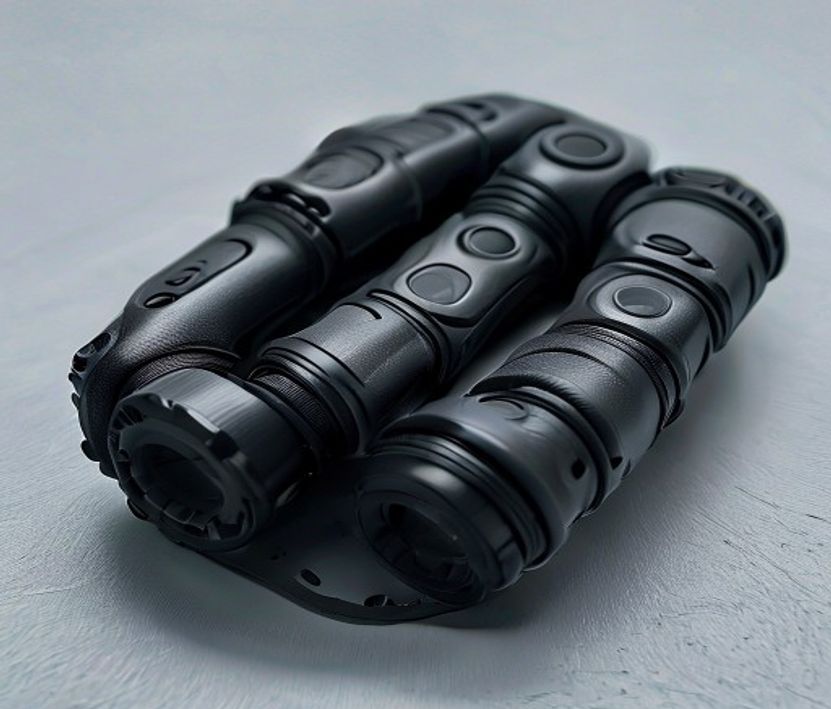
- Power tools: Glass-filled PA6 body overmolded with soft-touch TPE for grip, vibration damping, and impact protection. This is the largest commercial application of nylon overmolding.
- Automotive interior: PA66 structural brackets overmolded with TPE seals for HVAC components, pedal assemblies, and door modules.
- Медицинские изделия: Nylon surgical instrument handles with TPE grips for ergonomics and slip resistance after repeated sterilization.
- Бытовая электроника: Nylon chassis frames with integrated TPE seals for water-resistant smartphones, tablets, and wearables.
- Fluid handling: Nylon valve bodies with TPE or silicone seals molded in-place, eliminating O-ring assembly steps.
Process Requirements
| Параметр | Nylon Substrate | TPE Overmold |
|---|---|---|
| Melt temperature | 260–290°C | 180–230°C |
| Температура пресс-формы | 80–100°C | 30–60°C |
| Injection speed | Medium-fast | Fast (minimize cooling before contact) |
| Transfer time | <5 seconds for hot transfer; <30 sec for indexed tool | |
Почему стоит выбрать нейлоновый пластик для своих инженерных нужд?
- ✅ 300+ термопластавтоматов от 50T до 2000T
- ✅ 10 000+ деталей в день производственные мощности
- ✅ Точность ±0,02 мм допуск на все материалы
- ✅ MOQ только 1 шт. для создания прототипов; масштабируется до миллионов
- ✅ Круглосуточное цитирование, Срок изготовления 3-15 дней
- ✅ Сертифицированная система менеджмента качества ISO 9001
Похожие статьи
- Two-Shot Molding vs Overmolding — Multi-Material Processing Compared
- Руководство по литью под давлением нейлона: технологические параметры, передовой опыт
- От концепции до пресс-формы: процесс проектирования деталей из нейлона
ЧАСТО ЗАДАВАЕМЫЕ ВОПРОСЫ
When does Nylon Overmolding: Complete Guide to Multi-Material Injection Molding make sense?
Nylon Overmolding: Complete Guide to Multi-Material Injection Molding makes sense when the part volume, material choice, geometry, and repeatability needs justify mold design and tooling investment.
What design factors matter most for Nylon Overmolding: Complete Guide to Multi-Material Injection Molding?
На качество литой детали влияют такие факторы, как толщина стенок, ребра, выступы, угол наклона, расположение литника, усадка, линия разъема и выталкивание.
Какая информация необходима перед изготовлением пресс-формы?
Поставщик должен подтвердить 3D-модель, материал, предполагаемый годовой объем, требования к внешнему виду, допустимые отклонения, а также любые требования к сборке или функциональным испытаниям.
What is the biggest risk in Nylon Overmolding: Complete Guide to Multi-Material Injection Molding?
Наибольший риск заключается в утверждении инструментария до того, как поведение материала, усадка, течение и функциональность детали будут полностью проверены в условиях реального применения.