I once watched a junior engineer spec PEEK for a simple spacer that could’ve been Delrin. The material cost alone was 15x higher, and the machining time doubled because PEEK is finicky as hell to cut. When I asked why, he shrugged and said: “It was the first engineering plastic that came up on Google.”
That’s the problem with material selection. There are hundreds of options, spec sheets read like marketing brochures, and the difference between a great choice and a terrible one is often invisible until the parts arrive and don’t work. I’ve been on both sides of that equation — the guy making the parts and the guy specifying them. This guide is what I wish I’d had twenty years ago.
No theoretical mumbo-jumbo. Just which materials actually machine well, what they cost, and when you should (and shouldn’t) use them.
Основные понятия и принципы
Before we get into specific materials, you need to understand three things that determine whether a material is going to be a joy or a nightmare to machine.
Обрабатываемость is the big one. It’s a rating — usually on a percentage scale where 160 Brinell B1112 steel is the 100% baseline — that tells you how easily a material cuts. High machinability means fast cycle times, long tool life, and great surface finish. Low machinability means slow feeds, burned-up end mills, and parts that cost 3-5x more than you budgeted.
Thermal behavior matters more than people think. Aluminum expands like crazy when it heats up — about twice as much as steel. If you’re machining a precision bore at room temperature and the part will run at 80°C in service, you need to account for that growth. Plastics are even worse: nylon absorbs moisture from the air and swells dimensionally. Leave a tight-tolerance nylon bushing in a humid warehouse over the weekend, and it might not fit on Monday morning.
Work hardening is the silent killer. Certain stainless steels and nickel alloys get harder as you cut them. If your feed rate is too low or your tool dwells, the material surface hardens up, and the next pass either breaks the tool or leaves a garbage finish. Experienced machinists know this; inexperienced ones learn it the expensive way.
The material you pick doesn’t just affect the final part — it controls the entire manufacturing process. Choose wrong, and you’re fighting the material at every step. Choose right, and the chips fall exactly where they should.
Основные процессы и технологии
Different materials demand different approaches. Here’s what actually happens on the floor for each major material family.
| Material Family | Typical Machining Approach | Cutting Speed Range | Coolant Strategy | Tooling Notes |
|---|---|---|---|---|
| Aluminum (6061, 7075) | High-speed milling with carbide, aggressive feeds | 300-800 m/min | Flood coolant or MQL mist; prevents built-up edge on the tool | Uncoated carbide works great; 3-flute for roughing, 2-flute for finishing deep pockets |
| Stainless Steel (304, 316) | Moderate speed, high feed, rigid setup | 60-150 m/min | Heavy flood coolant essential; keeps work hardening in check | TiAlN-coated carbide mandatory; sharp edges only — dull tools cause instant work hardening |
| Carbon Steel (1018, 1045) | Standard speeds, HSS or carbide tooling | 100-250 m/min | Flood coolant or heavy cutting oil | Carbide for production, HSS for one-offs; 45° lead angle reduces shock on entry |
| Brass & Copper | High speed, sharp tools, watch for burrs | 200-500 m/min | Light coolant or dry; copper needs cooling to prevent thermal expansion errors | Sharp HSS tools with high rake angle; copper is gummy — polished flutes prevent chip welding |
| Titanium (Ti-6Al-4V) | Low speed, high feed, maximum rigidity | 30-60 m/min | High-pressure coolant through the spindle; keeps the cutting zone cool | Specialized geometries, high-helix; tool life is short — budget for it; never let the tool rub |
| Engineering Plastics (POM, Nylon, ABS) | High speed, sharp tools, light cuts | 200-600 m/min | Air blast preferred; coolant can cause dimensional swelling in hygroscopic plastics | Sharp polished carbide; positive rake; watch for melting — too slow and the plastic welds to the tool |
| High-Performance Plastics (PEEK, PEI/Ultem) | Moderate speed, annealed stock if possible | 100-300 m/min | Light coolant or air; stress-relieved material machines best | Carbide only; these plastics eat HSS; anneal the stock before finish-machining to prevent warping |
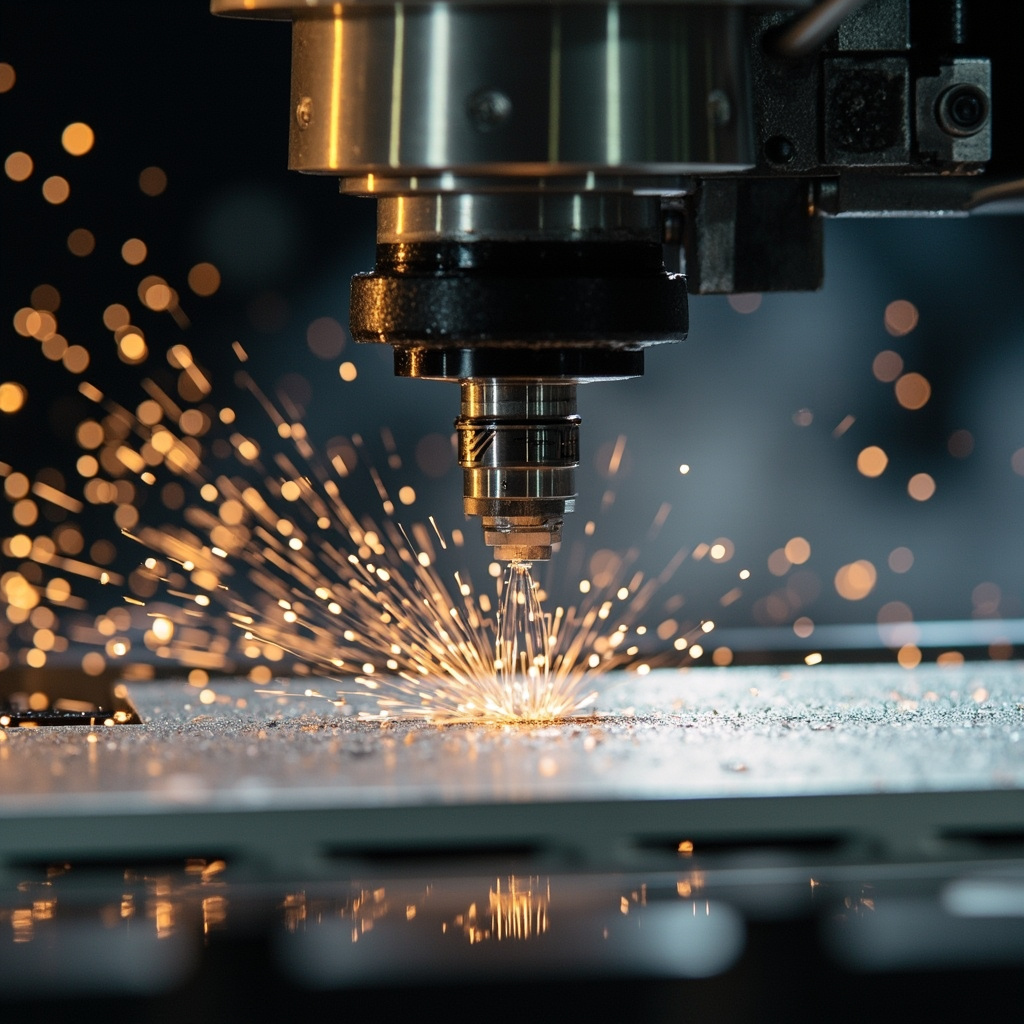
The coolant strategy for plastics catches a lot of people off guard. Most plastics don’t need cooling — they need chip evacuation. If you flood nylon with water-based coolant, the part absorbs it and grows. Come back after lunch and your ±0.02mm tolerance is blown. Air blast is cleaner and safer for most plastics. We’ve learned that lesson the hard way more times than I’d like to admit.
Промышленное применение
Here’s what gets spec’d where, based on thousands of jobs across our shop floor.
| Промышленность | Заявка | Материал | Основное требование | Преимущества nylonplastic.com |
|---|---|---|---|---|
| Автомобили | Engine mounting bracket | Алюминий 6061-T6 | Vibration resistance, corrosion resistance | Hard anodize coating adds wear resistance; in-house CMM verifies all critical dimensions before shipment |
| Аэрокосмическая промышленность | Actuator housing | Aluminum 7075-T651 | High strength-to-weight, fatigue life certification | Full material traceability with mill certs; NADCAP-compliant special processes available |
| Медицина | Surgical instrument handle | Stainless Steel 17-4PH H900 | Autoclavable, biocompatible, ergonomic finish | Electropolishing to Ra <0.4μm eliminates bacterial adhesion points; passivation per ASTM A967 |
| Электроника | RF shielding enclosure | Aluminum 6061 + Electroless Nickel | EMI shielding, conductivity, corrosion protection | Electroless nickel delivers uniform 25μm coating inside deep pockets; salt spray tested to 96 hours |
| Промышленное оборудование | Wear plate for packaging machine | Delrin (POM) Natural | Low friction, dimensional stability, self-lubricating | Stress-relieved stock prevents post-machining warping; tight flatness spec held to 0.05mm over 300mm length |
| Роботизированная автоматизация | End-effector mounting plate | Алюминий 7075-T6 | Stiffness, minimal deflection under dynamic loads | 5-axis machining in single setup eliminates stack-up errors; weight-optimized pocketing reduces inertia |
| Нефть и газ | Downhole sensor body | Нержавеющая сталь 316L | Corrosion resistance at 150°C+, pressure integrity | Thread milling to precise gauge fit; helium leak testing available for pressure-critical assemblies |
Выбор материала — что действительно работает
Let’s go material by material. I’ll give you the straight story — machinability, typical cost, and when to use it.
Aluminum Alloys
6061-T6 is the default. It machines beautifully, anodizes well, welds decently, and costs about $3-5/kg in plate form. If you’re not sure what aluminum to use, start here. It’s the Toyota Camry of materials — not exotic, but it does everything competently. Tensile strength around 310 MPa, good corrosion resistance, available everywhere.
7075-T6 is 6061’s stronger, more expensive cousin. Think 570 MPa tensile — approaching mild steel territory at a third the weight. More expensive (roughly 2x 6061), slightly harder to machine, and it doesn’t weld or anodize as nicely. Use it when you need aircraft-grade strength and weight matters more than cost. Aerospace brackets, drone components, high-stress robotic parts.
5083 is the marine-grade choice. Exceptional corrosion resistance in saltwater environments. Softer than 6061, which means it’s gummier to machine — sharp tools and coolant are non-negotiable. Use it for offshore equipment, boat fittings, and anything that lives in salt spray.
MIC-6 is cast aluminum tooling plate. It’s stress-relieved and dead flat — we use it for plates, vacuum chucks, and anything where flatness trumps strength. Easier to machine than rolled plate because there are no residual stresses to release. About 2x the cost of 6061 plate.
Steel Alloys
1018 (Mild Steel) is the budget workhorse. Machinability rating around 78% — cuts nicely, great surface finish, welds like a dream. Tensile is modest (~440 MPa), and it’ll rust if you look at it wrong. Case hardening can help with wear resistance. Good for general-purpose brackets, shafts, and non-critical structural parts.
4140 (Alloy Steel) is 1018’s grown-up sibling. Pre-hardened to 28-32 HRC, it machines well (66% machinability) and delivers 2-3x the strength. Use it for gears, axles, tooling bodies, and anything that sees cyclic loading. Available pre-hardened or annealed.
Нержавеющая сталь 304 is the most common stainless we machine. Corrosion resistance is excellent, but machinability is poor — about 45%. It work-hardens if you baby it, so you have to commit: aggressive depth of cut, steady feed, no dwelling. TiAlN-coated carbide is mandatory. Use it for food processing equipment, chemical handling, medical devices, and architectural fittings.
Stainless 316 is 304 plus molybdenum — better pitting resistance, especially in chloride environments. Machinability is slightly worse (~40%). Cost is about 30% higher than 304. Use it for marine, pharmaceutical, and any application where salt or aggressive chemicals are present.
Stainless 17-4PH is precipitation-hardening stainless. In the H900 condition (aged at 900°F), it hits 1,300+ MPa tensile — that’s stronger than some tool steels, with stainless-level corrosion resistance. Machinability in the solution-treated condition is decent (~50%). We machine it, then the customer heat-treats it (or we arrange it). Medical instruments, aerospace actuators, high-end valve components.
Stainless 303 is the “free-machining” stainless — machinability around 78%, dramatically easier than 304. The trade-off? Slightly lower corrosion resistance and it’s non-weldable (the sulfur that makes it machine well wrecks the weld puddle). Use it for non-welded precision components where you need stainless but also need it to not cost a fortune to make.
Brass & Copper
C360 (Free-Machining Brass) is a machinist’s dream. Machinability rating: 100%. It’s literally the definition of “machines like butter.” Excellent for threaded fittings, valve bodies, decorative hardware, and low-friction bushings. Not the strongest (tensile ~400 MPa), but when you need precision and sparkle, brass delivers. Lead content (~3%) means it’s not for potable water in some jurisdictions.
C110 (Electrolytic Tough Pitch Copper) is pure copper — 100% IACS conductivity, ideal for electrical bus bars, heat sinks, and welding electrodes. Very gummy to machine (machinability ~20%). Chip control is the biggest headache; it wants to form long stringy ribbons that wrap around the tool. Sharp polished carbide and aggressive chip-breaking strategies are essential. Budget extra machining time.

Инженерные пластики
Delrin (POM / Acetal) is the king of machinable plastics. Machines like aluminum, holds ±0.05mm without drama, and doesn’t absorb moisture (unlike nylon — this matters). Great for gears, bearings, rollers, and any wear component. The natural white machines cleanest; black Delrin has slightly different properties due to the pigment. Cost is moderate — around $15-25/kg for plate. One warning: Delrin is slippery. Your vise needs to clamp hard, and you can’t be shy with the torque, or the part will move mid-cut.
Нейлон 6/6 is tougher and more abrasion-resistant than Delrin, but it absorbs moisture like a sponge. A nylon part machined to ±0.05mm tolerance on a dry Tuesday might be ±0.15mm on a humid Thursday. If you’re using nylon for anything precision, you need to account for this — or switch to Delrin. Good for wear pads, cable sheaves, and impact-resistant components where a little dimensional drift is acceptable.
ABS machines reasonably well but melts at the drop of a hat. If your RPM is too high or your feed too low, the tool friction melts the plastic, and you get a gummy mess instead of chips. Air blast helps. Good for enclosures, housings, and cost-sensitive prototypes. Not structural — think of it as a step up from 3D printing in terms of material properties.
Поликарбонат is optically clear and impact-resistant — think bulletproof glass toughness. The challenge: it’s brittle-tough, which means it can chip at the exit edges if your tool geometry isn’t right. Sharp carbide, low helix angle, and backing up the exit side with scrap material if possible. Good for transparent covers, sight glasses, and impact-resistant windows.
High-Performance Plastics
PEEK is the exotic you spec when nothing else survives. Continuous use temperature up to 250°C, chemical resistance better than almost anything, and mechanical properties that compete with aluminum at a fraction of the weight. It also costs $100-200/kg for plate stock and requires annealed material to machine without internal stress releasing mid-cut. Medical implants, aerospace insulators, semiconductor equipment. If Delrin is a Toyota, PEEK is a Porsche — incredible when you need it, expensive overkill when you don’t.
PEI (Ultem) is the budget alternative to PEEK. Glass transition around 217°C, excellent flame-smoke-toxicity ratings, and commonly found in aircraft interiors. Machines similarly to PEEK — needs sharp carbide and moderate speeds. About half the cost of PEEK. Great for electrical insulators, aerospace interior brackets, and medical device components that get autoclaved.
PTFE (тефлон) is the slipperiest solid you can machine. Coefficient of friction around 0.05 — almost nothing sticks to it. It’s also soft, gummy, and dimensionally unstable with temperature changes. Machining PTFE is like cutting a block of soap — the material deforms before it cuts clean. Sharp tools, light cuts, patience. Use it for seals, gaskets, chemical-resistant liners, and anywhere you need something to slide without lubrication.
Компромиссы между стоимостью и производительностью
Material cost is only part of the picture. The real cost of a machined part is material + machining time + tooling wear + scrap risk. Some “cheap” materials cost more in the spindle than others.
Here’s the hierarchy, ranked by total part cost for a typical palm-sized component:
- Алюминий 6061 — cheapest all-in. Fast cycle times, long tool life, cheap material.
- Delrin (POM) — very close to aluminum. Less rigid fixturing needed, faster speeds.
- Латунь C360 — cheap material, fast machining, but material cost is 3-4x aluminum.
- Mild Steel 1018 — material cost is low, but slower feeds than aluminum mean more spindle time.
- Stainless 303 — machines decently, material cost 4-5x aluminum.
- Нейлон 6/6 — material is cheap but fixturing is finicky; dimensional uncertainty adds risk.
- Алюминий 7075 — material cost 2x 6061, slightly slower speeds, premium for strength.
- Stainless 304/316 — machining is 3-5x slower than aluminum, tooling costs are higher, material is 5-6x aluminum.
- ABS / Polycarbonate — cheap material but melting risk slows you down; inconsistent results.
- PEEK — material cost 30-50x aluminum, plus annealing, plus slow machining. Only use when you have no choice.
- Титан Ti-6Al-4V — material cost 15-20x aluminum, machining speed is glacial, tool life is measured in minutes not hours.
Pro tip: If you’re cost-sensitive and your parts are complex, talk to us about material choice before locking the design. A bracket designed for 304 stainless that would work perfectly fine in 6061 aluminum with hard anodize could cut your per-part cost by 60-70%. We see this all the time — engineers over-spec materials “just to be safe” and pay for it.
Стандарты качества и передовой опыт
Quality starts with the material blank. Here’s what we check before the spindle ever spins.
Сертификация материалов: For aerospace, medical, and oil & gas work, we require mill test reports (MTRs) that trace the material back to the heat lot. The cert tells you chemical composition, mechanical properties, and heat treatment condition. No MTR, no flight part — that’s the rule. For commercial work, MTRs are optional but available on request.
Incoming : Every batch of material we receive gets a hardness check and dimensional verification. Aluminum plate that’s supposed to be 25.4mm thick is measured in three places. If it’s out, the CAM adjusts — but we need to know before we start cutting.
Stress relief: Rolled plate and extruded bar stock carry residual stresses from manufacturing. When you machine away 70% of the material, those stresses release and the part can warp. For critical flatness parts, we stress-relieve the stock first (thermal treatment) or use pre-stress-relieved materials like MIC-6 aluminum. Plastics like PEEK and Ultem should be annealed before finish-machining.
In-process : First article gets a full dimensional check. Production parts get statistical sampling based on lot size and criticality. We probe critical features on the machine between tool changes. If a tool wears and a bore starts drifting, we catch it before it becomes scrap.
Surface finish: Standard machined finish is Ra 1.6-3.2 μm, which is perfectly functional for most applications. We can hit Ra 0.4 μm or better with the right and a finishing pass — but every micron you shave off the surface roughness doubles the cutting time on that feature. Know what you actually need.
Начало работы — практические шаги
If you need machined parts and aren’t sure what material to use, here’s the no-nonsense process:
Step 1: Define the must-haves. What does this part absolutely need to do? Withstand 200°C? Survive saltwater? Hold a ±0.01mm press fit? Don’t jump to a material — define the requirements first. Write them down. Strength, temperature, chemical exposure, electrical properties, weight limits, cosmetic requirements.
Step 2: Start with the obvious candidate. For most mechanical parts, 6061 aluminum is the right starting point. It’s cheap, machines fast, anodizes nicely, and is strong enough for 80% of applications. From there, adjust: need more strength? 7075. Need corrosion resistance? 304 stainless or anodized 6061. Need electrical insulation? Delrin or PEEK.
Step 3: Check machinability. Before you lock in that exotic alloy, check how painful it is to machine. 304 stainless is doable but 3x the cost of 6061. Titanium is possible but 10x. Ask your machine shop before you spec the material — we can tell you what’s going to drive the price up and suggest alternatives that hit the same requirements.
Step 4: Get a sample. If you’re spec’ing a material you’ve never used before, order a single prototype part first. Test it in your actual application. A $200 prototype that fails is infinitely cheaper than 500 production parts that don’t work.

Заключение
Material selection isn’t about finding the “best” material — it’s about finding the right one for ваш part. I’ve seen beautiful designs fail because someone spec’d a material that was too brittle, too soft, too expensive, or too difficult to hold tolerance on. I’ve also seen simple aluminum brackets outperform exotic alloys because the material matched the job.
Start with the requirements. Match the material to the function. If you’re stuck, ask the people who’ll be making the parts — we’ve seen what works and what doesn’t, and we’re usually happy to point you in the right direction. The five minutes you spend on material selection before the design is locked will save you weeks of headaches and thousands in scrap down the road.
Your machinist will thank you. So will your budget.
Plastic Material Questions Before CNC Quotation
| Buyer Requirement | Material Question | Quotation Risk |
|---|---|---|
| Tight fit or flatness | What stock condition, moisture state, stress relief, and inspection temperature apply? | Metal-like tolerances are quoted on unstable plastic geometry |
| Wear or sliding | Are friction, PV, lubrication, counterface, and temperature defined? | A strong plastic fails by heat or wear |
| Воздействие химических веществ | Are concentration, time, stress, and temperature known? | A family-level compatibility claim is overextended |
| Transparent or cosmetic part | Which surface, clarity, tool-mark, and polish standard is required? | Finishing scope is omitted from the quote |
Как нейлоновый пластик способствует реализации проекта
Nylon Plastic has supported material selection and finished plastic-part manufacturing since 2005. The same project review can connect stock selection, workholding, machining sequence, stress control, and final inspection, so buyers do not have to evaluate each production decision in isolation.
- Review the drawing, material, quantity, critical features, and use environment before quotation.
- Compare 3D printing, CNC machining, rapid tooling, and production molding when more than one route is practical.
- Define samples, dimensional reports, material documents, traceability, and acceptance criteria before release.
Related Reading
- Обработка материалов с ЧПУ
- Пластиковые детали, изготовленные по индивидуальному заказу
- CNC Plastic Machining Tolerances
Часто задаваемые вопросы
Which plastic is easiest to CNC machine accurately?
POM is often a stable starting point, but material choice must follow load, temperature, wear, chemicals, compliance, and stock availability rather than machinability alone.
Why are plastic tolerances different from metal tolerances?
Plastics are generally less stiff and more responsive to heat, moisture, residual stress, and clamping. Geometry and inspection condition therefore matter more.
When should nylon be chosen for machined parts?
Nylon is useful for wear parts, gears, rollers, and impact-tolerant components, but moisture-conditioned dimensions and stock stress need review for tight fits.
What belongs in a CNC material RFQ?
Include CAD, drawing, exact or preferred grade, quantity, load, temperature, chemicals, critical datums, finish, inspection condition, and required documents.
Request a CNC Material Review
Send the drawing and service conditions to compare nylon, POM, PC, PEEK, PTFE, UHMW, or other qualified stock materials.