
This nylon 6 nylon guide explains practical considerations for material selection, design review, manufacturing, and sourcing decisions.
Nylon 6 vs Nylon 66 is one of the most common engineering plastic comparisons because the best choice depends on moisture exposure, strength targets, heat load, and processing needs.
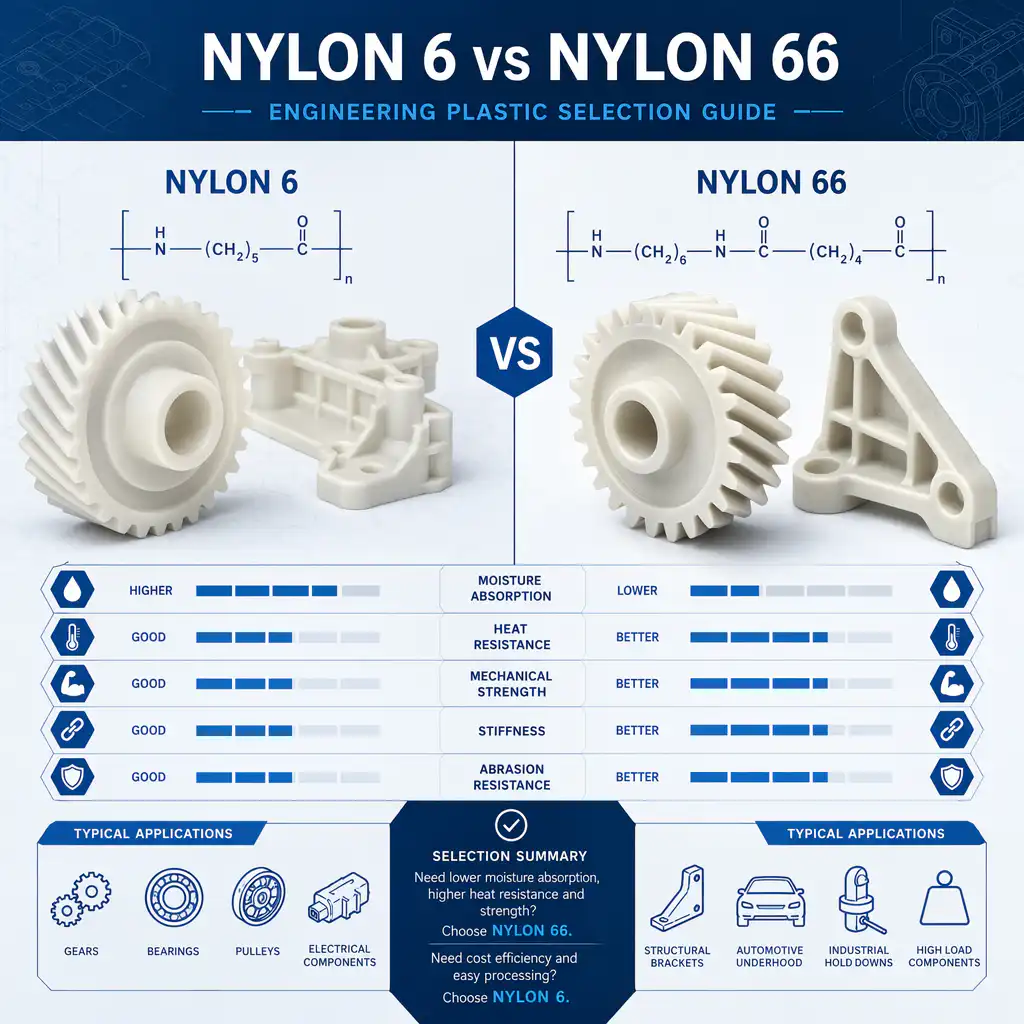
In short, Nylon 6 is often preferred for toughness, easier processing, and lower cost, while Nylon 66 is usually chosen when higher heat resistance, stiffness, and creep performance matter more. For reinforced grades, see our PA66 GF30 guide and for fluid exposure, compare nylon chemical resistance.

Chemical Structure Differences
The fundamental difference between PA6 (нейлон 6) и PA66 (нейлон 66) lies in their molecular structure:
- Nylon 6: Made from caprolactam, has 6 carbon atoms in each repeating unit. Less crystalline structure.
- Nylon 66: Made from hexamethylenediamine and adipic acid, has two 6-carbon chains. More crystalline structure.
Сравнение механических свойств
| Недвижимость | PA6 | PA66 |
|---|---|---|
| Прочность на разрыв | 70-85 MPa | 80-100 MPa |
| Модуль упругости | 2.5-3.0 GPa | 2.8-3.5 GPa |
| Удлинение при разрыве | 30-100% | 15-60% |
| Ударная прочность по методу Изода с надрезом | 50-100 J/m | 40-80 J/m |
| Температура плавления | 220 °C | 260 °C |
| Температура HDT при давлении 1,8 МПа | 70°C | 90°C |
Поглощение влаги
Moisture absorption is critical for nylon applications:
| Condition | PA6 | PA66 |
|---|---|---|
| At 50% RH | 2.5-3.0% | 2.0-2.5% |
| Saturation | 8-10% | 6-8% |
Processing Characteristics
Nylon 6 Processing
- Температура плавления: 220 °C
- Processing Range: 240-280°C
- Температура формы: 40-80°C
Nylon 66 Processing
- Температура плавления: 260 °C
- Processing Range: 280-320°C
- Температура формы: 60-90°C
Applications by Material
Nylon 6 Applications
- Gears and sprockets
- Industrial monofilament
- Film and packaging
- Consumer products
Nylon 66 Applications
- Automotive under-hood components
- Electrical connectors
- High-temperature bearings
- Precision mechanical components
Reinforced Grades
Both materials are commonly reinforced with glass fiber:
| Класс | PA6 + GF30 | PA66 + GF30 |
|---|---|---|
| Прочность на разрыв | 140-160 MPa | 170-200 MPa |
| HDT (1,8 МПа) | 205°C+ | 250°C+ |
| Поглощение влаги | 1.0-1.5% | 0.8-1.2% |
Selection Summary
Choose Nylon 6 when:
- Impact resistance is critical
- Cost sensitivity is high
- Operating temperatures are moderate
Choose Nylon 66 when:
- Higher mechanical strength is required
- Elevated temperatures are expected
- Dimensional stability is critical
ЧАСТО ЗАДАВАЕМЫЕ ВОПРОСЫ
When is Nylon 6 vs Nylon 66 — Engineering Plastic Selection Guide a good option?
Nylon 6 vs Nylon 66 — Engineering Plastic Selection Guide is a good option when fast iteration, complex geometry, low tooling cost, or low-volume production is more important than molded-part unit cost.
What should be checked before choosing Nylon 6 vs Nylon 66 — Engineering Plastic Selection Guide?
Проверьте размер детали, свойства материала, качество обработки поверхности, допуск на размеры, тепловое воздействие, направление нагрузки и необходимость последующей обработки.
How does Nylon 6 vs Nylon 66 — Engineering Plastic Selection Guide compare with CNC machining?
3D-печать позволяет быстро создавать сложные формы, в то время как обработка на станках с ЧПУ часто более эффективна для получения точных поверхностей, более жестких допусков и материалов производственного класса.
What affects the cost of Nylon 6 vs Nylon 66 — Engineering Plastic Selection Guide?
Стоимость зависит от материала, объема сборки, времени печати, высоты слоя, удаления поддержки, финишной обработки, контроля и количества деталей в сборке.
Related Reading
- Нейлон против полипропилена: Руководство по выбору материала для инженерных применений
- Ацеталь (POM) против нейлона — какой инженерный пластик подходит для вашей задачи?
- Нейлон против ПБТ: полное сравнение инженерных термопластов
At a Glance
| Decision Point | PA6 | PA66 | Buyer Note |
|---|---|---|---|
| Impact / toughness | Strong | Strong | Compare actual part loading, not just resin family |
| Термостойкость | Хорошо | Usually better | PA66 often wins when temperature margin matters |
| Moisture response | Выше | Also high | Conditioning will affect both grades |
| Best use | General engineering parts | Hotter or more demanding parts | Use the part environment to decide the grade |
Why Choose Nylon Plastic
Nylon Plastic can help buyers separate PA6 and PA66 decisions when the part needs a practical balance of heat, toughness and molding cost.
Request a PA6 / PA66 Review
Send the application, target temperature and tolerance target for a quick grade recommendation.

