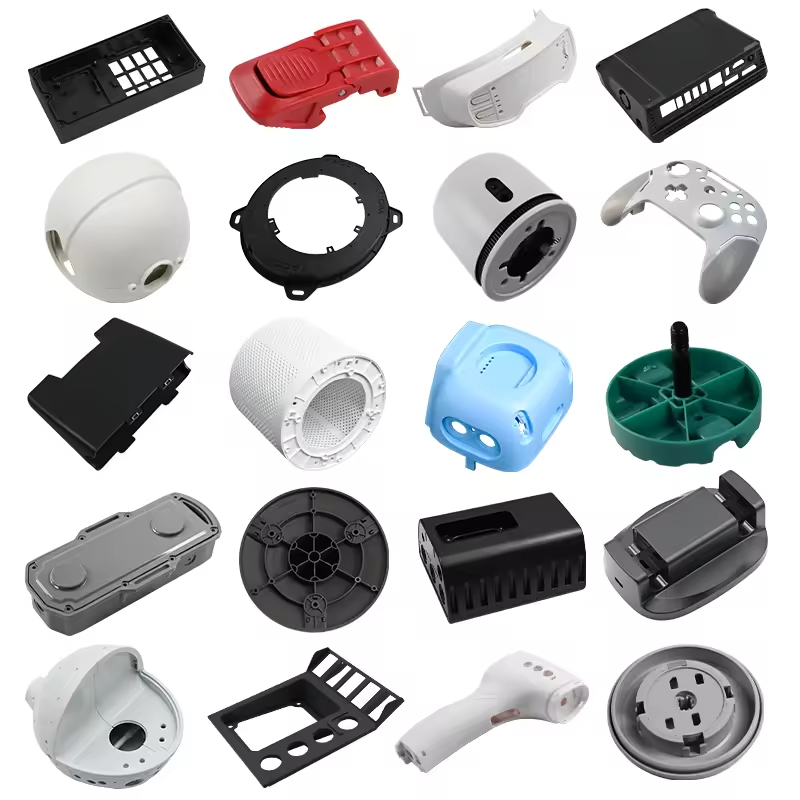
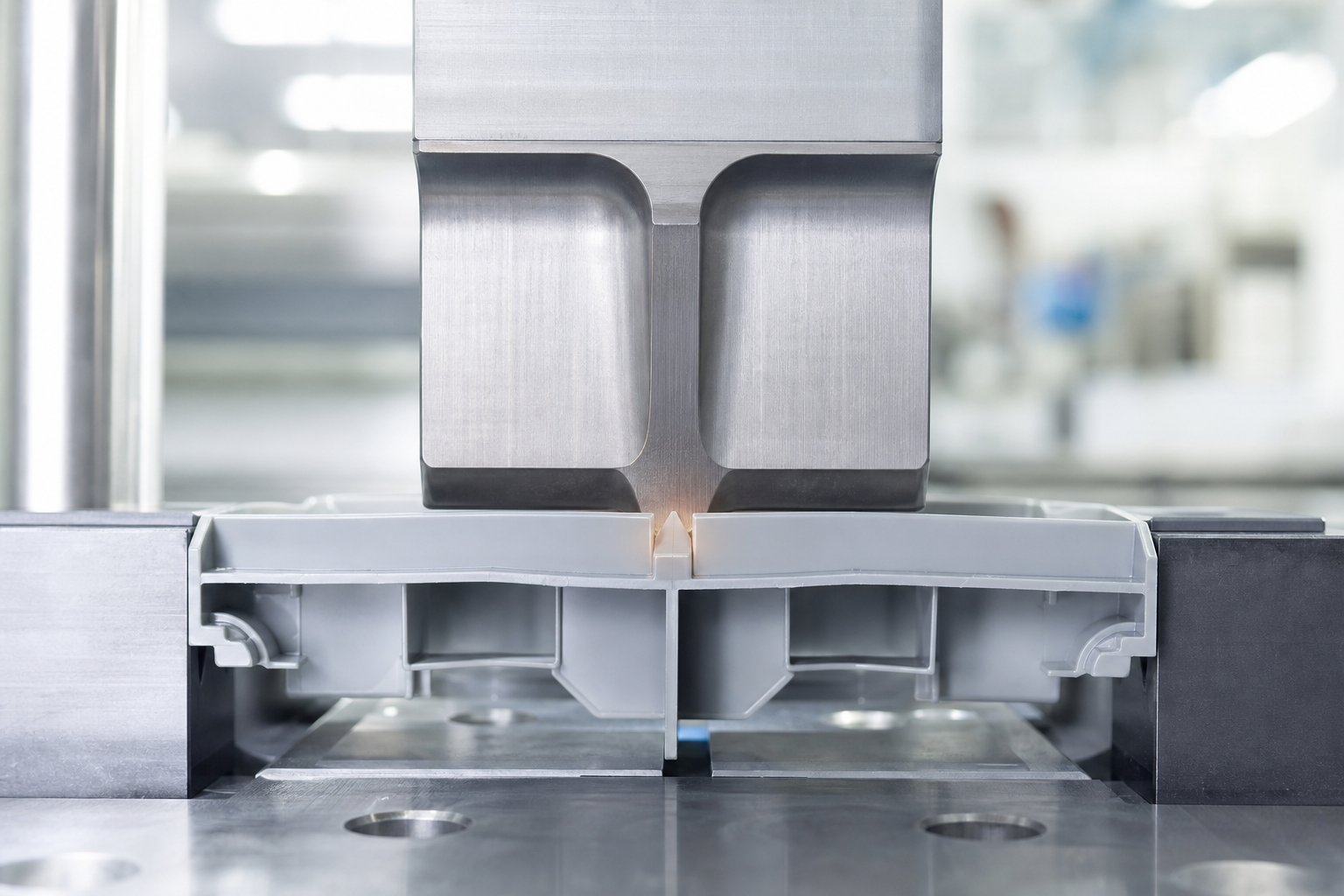
Injection molding produces individual parts, but many products require post-molding assembly to create a finished component. Plastic welding offers a permanent, clean joining method that avoids the cost and complexity of mechanical fasteners, while eliminating the chemical hazards and wait times of adhesives. Unlike snap-fits or screws, welding creates a monolithic bond with strength approaching the base material. This article compares five primary plastic welding methods used in production environments: ultrasonic, hot plate, vibration, laser, and spin welding. Understanding the trade-offs between these techniques is essential for selecting the right process for your part geometry, material, volume, and budget.
Ultrasonic Welding
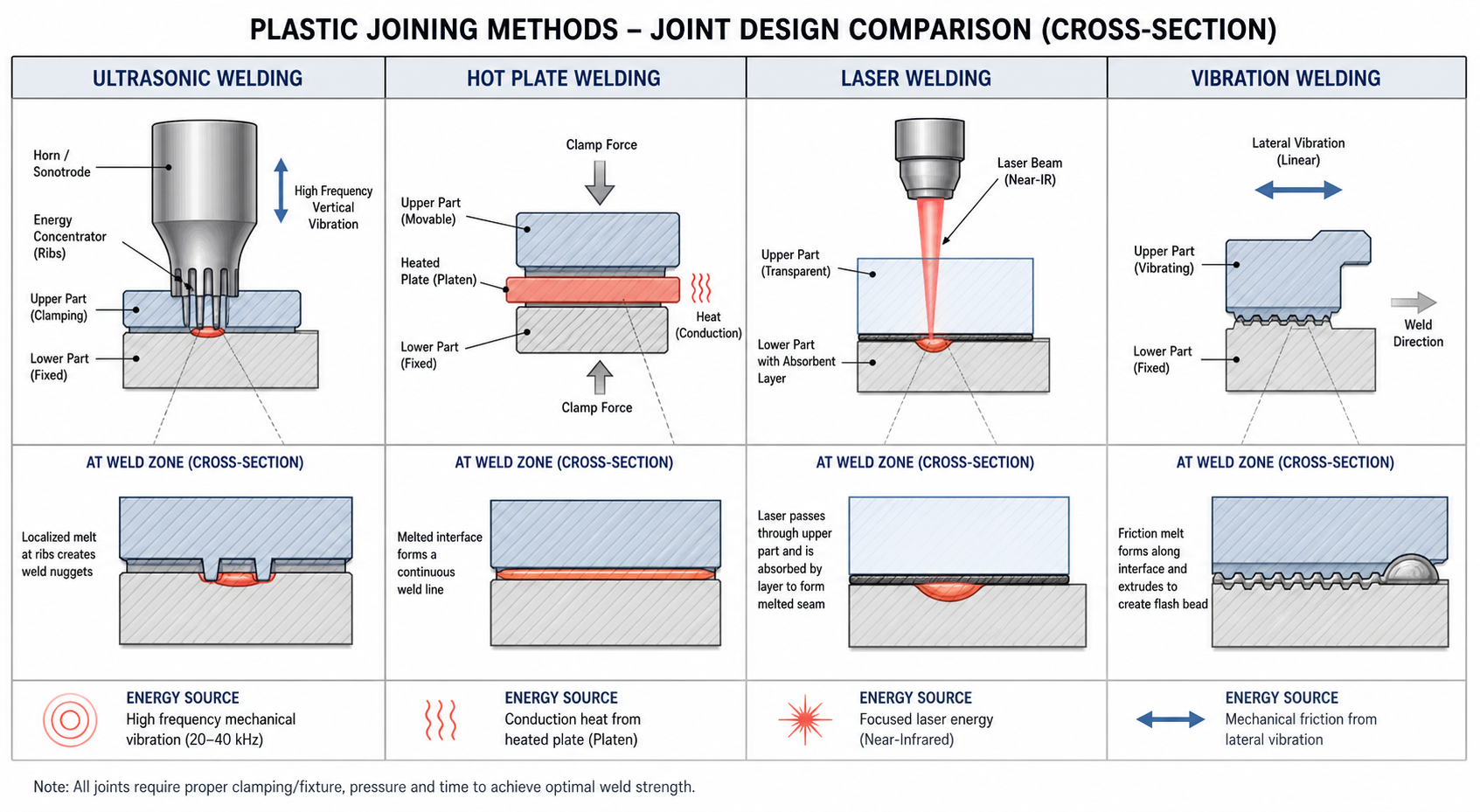
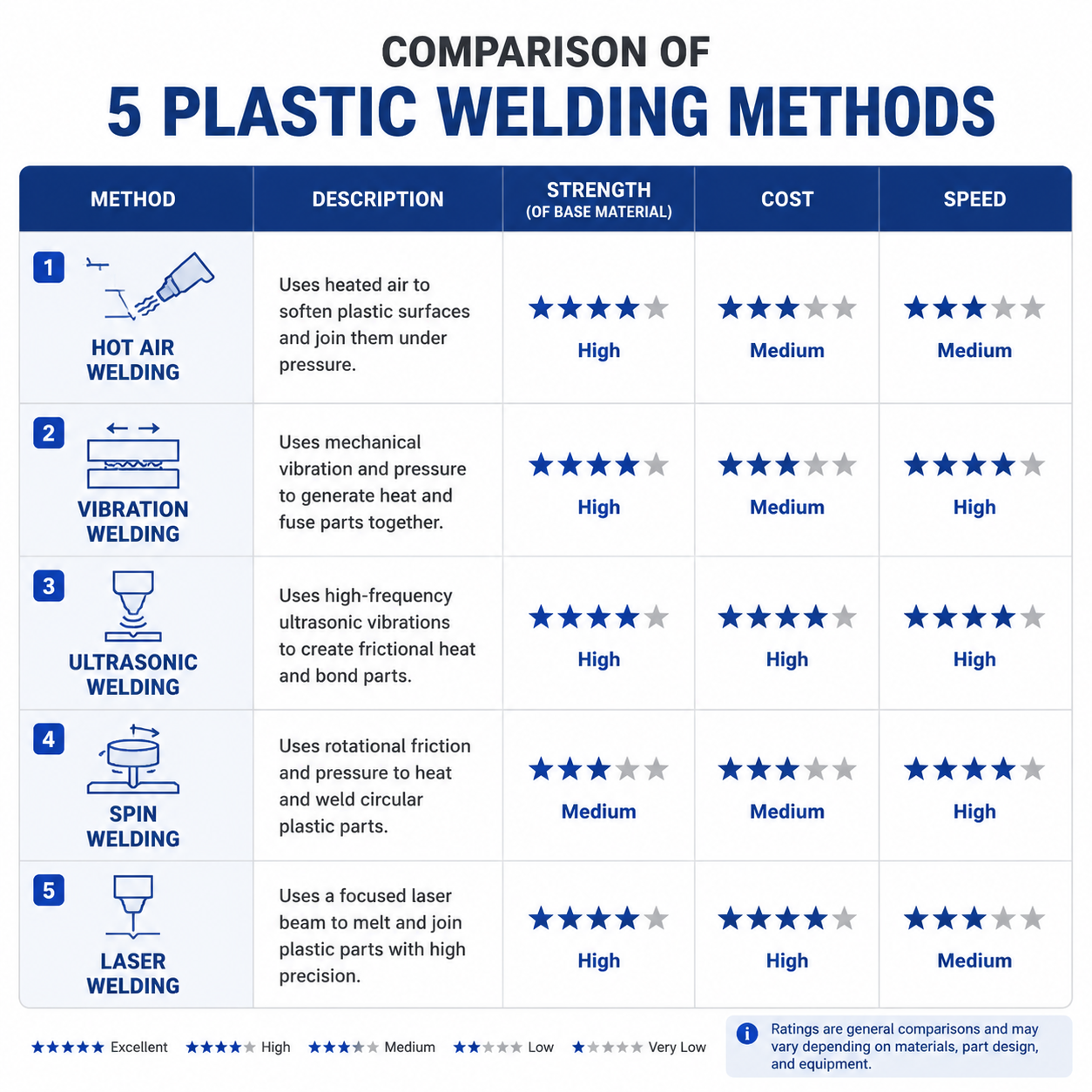
Ultrasonic welding uses high-frequency mechanical vibrations (20 kHz, 30 kHz, or 40 kHz) to generate frictional heat at the joint interface. A metal horn (sonotrode) presses against one part and transmits vibrations through the plastic, causing localized melting at the energy director. Typical cycle times range from 0.5 to 1.5 seconds, making it the fastest welding method available. Equipment costs range from ,000 to ,000 depending on power (500 W to 3000 W), frequency, and control features.
Rigid thermoplastics such as ABS, PC, PS, PMMA, PA (nylon), POM, and SAN weld well ultrasonically. Amorphous materials produce stronger bonds than semi-crystalline ones. Energy director design is critical: a V-shaped ridge (typically 60-90 degrees, 0.3-0.5 mm height) concentrates the vibrational energy at the joint interface. Joint configurations include shear joints for hermetic seals and butt joints for simpler geometries.
Сварка на нагревательной плите
Hot plate welding brings both part surfaces into contact with a heated platen until they melt, then removes the platen and presses the parts together to fuse. Temperature accuracy is critical: typical hot plate temperatures range from 200-400 degrees C depending on the material. Cycle times are longer, typically 10 to 30 seconds per weld, including heating and cooling phases. Equipment costs range from ,000 to ,000 depending on size and control precision.
This method excels for large parts and assemblies where other methods cannot deliver uniform energy distribution. It works with nearly all thermoplastics, including glass-filled nylon (PA66 GF30), polypropylene, and polyethylene. The main disadvantages are the longer cycle time and the potential for material sticking to the hot plate surface. Non-stick coatings (PTFE) mitigate this issue.
Вибрационная сварка
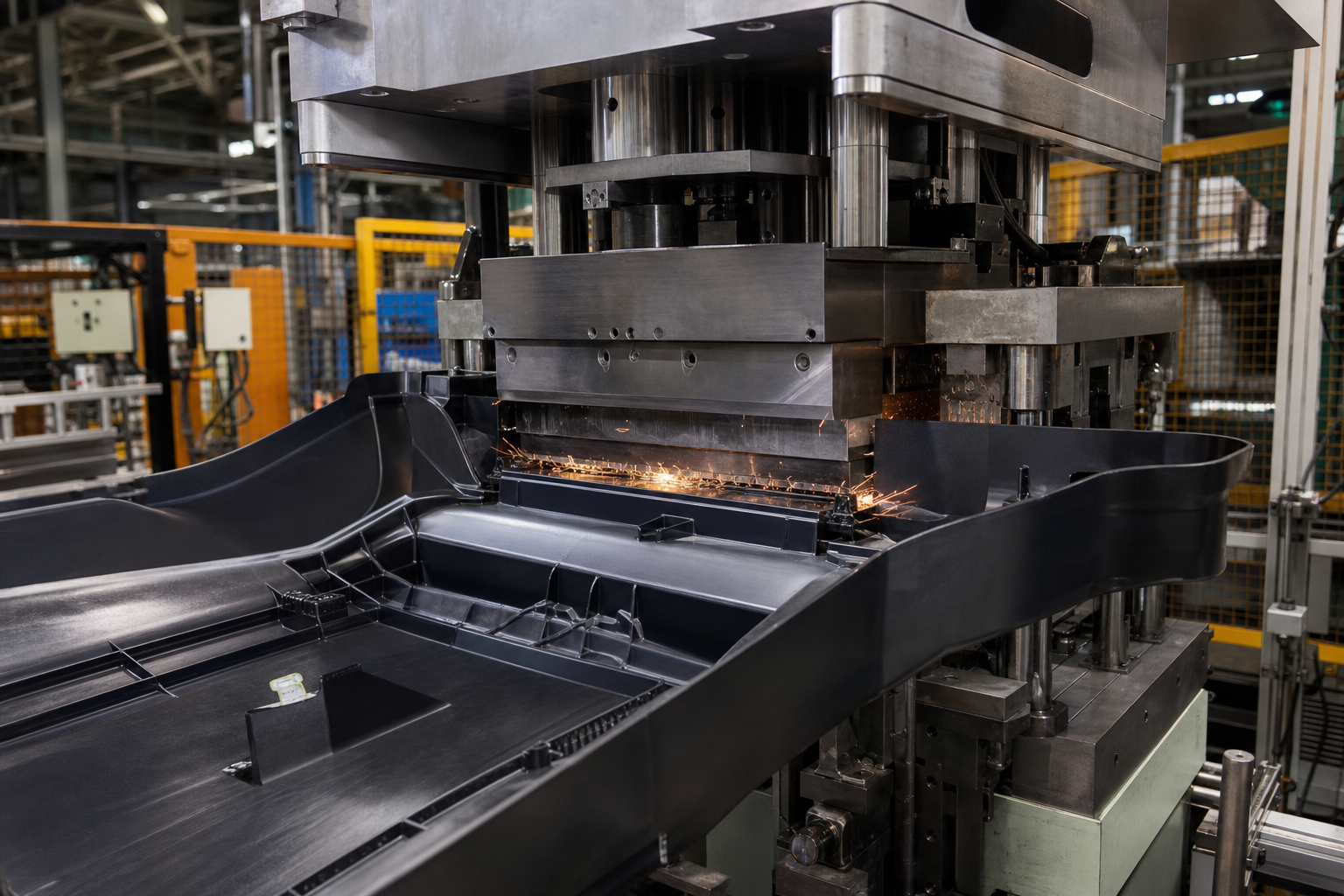
Vibration welding (also called friction welding) generates heat through linear or orbital motion of one part against the other at frequencies of 120-240 Hz, with amplitudes from 0.7 to 4.0 mm. Linear vibration welding reciprocates in one axis, while orbital welding creates a circular motion for better energy distribution on irregular shapes. Cycle times range from 2 to 10 seconds, and equipment costs range from ,000 to ,000.
The method is ideal for large, irregularly shaped parts that cannot be welded by ultrasound. Joint design requires a flat mating surface with a flash trap to contain the molten material. Vibration welding is compatible with most thermoplastics including PA66, PP, PE, POM, ABS, and PC. Semi-crystalline materials benefit from the sustained frictional heat, which melts the crystalline structure thoroughly. Hermetic seals are achievable with proper joint design.
Лазерная сварка
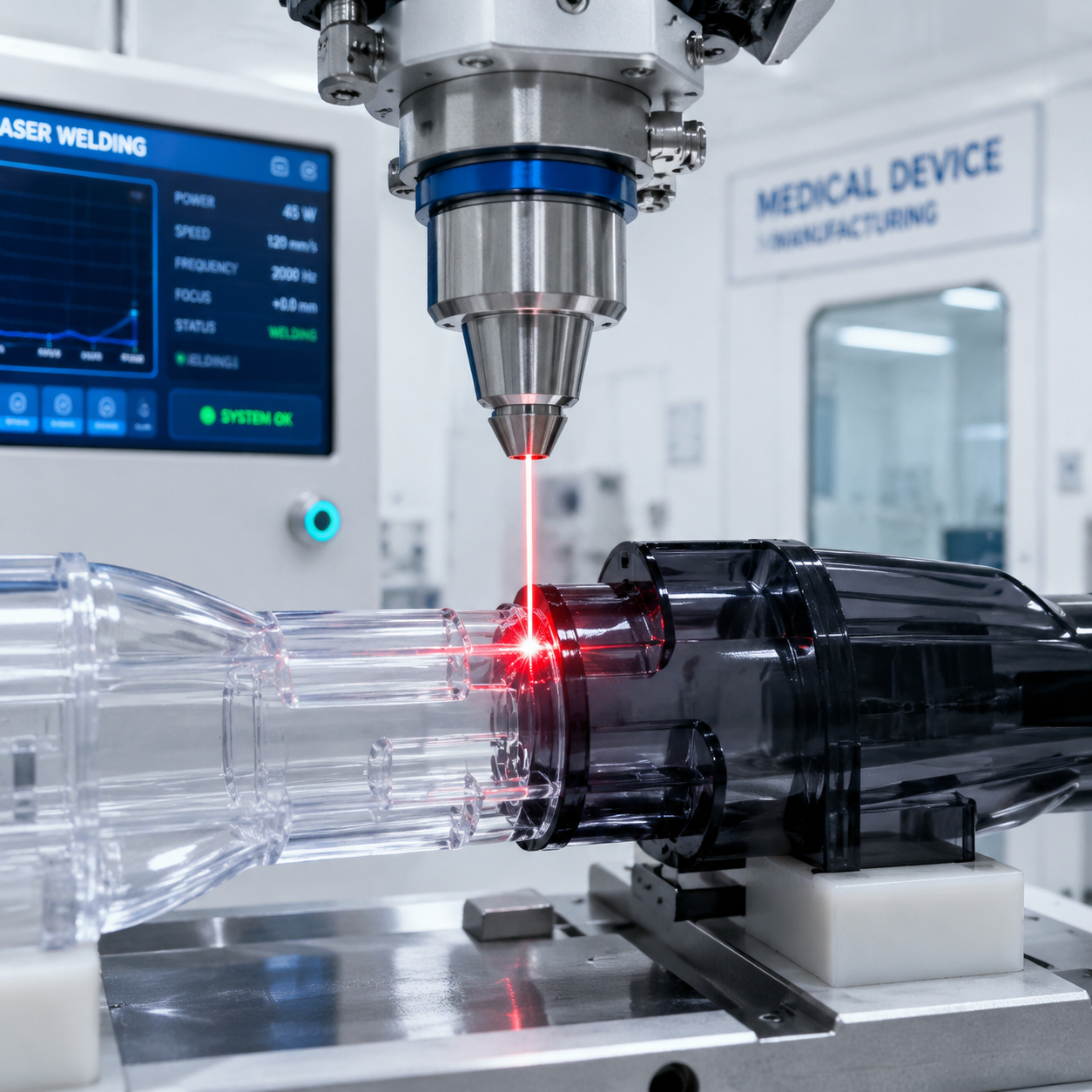
Laser welding uses the through-transmission principle: a laser beam passes through a laser-transparent top layer and is absorbed by a laser-absorbent bottom layer, melting the interface. Typical sources are diode lasers (800-1000 nm) or fiber lasers. The top part must be clear to the laser wavelength (natural or lightly colored), while the bottom part is typically dark, black, or contains an absorbing additive. Weld speeds can reach 10-20 m/min for continuous seams.
Laser welding delivers the highest precision of all methods, with weld widths as narrow as 0.1-0.5 mm. It generates no particulates, flash, or vibration, making it suitable for clean-room applications and sensitive electronics. Equipment costs are high, ranging from ,000 to ,000. It is best suited for small-to-medium parts where cosmetic appearance and precision matter, such as medical devices, sensors, and automotive electronics.
Spin Welding
Spin welding is the simplest welding method, suitable exclusively for circular or cylindrical parts. One component is rotated against a stationary part under controlled pressure until frictional heat melts the interface, then rotation stops and pressure is maintained during cooling. Equipment costs range from ,000 to ,000, and cycle times are 1 to 3 seconds. The technique works well for parts like filter housings, bottles, and round connectors. Material compatibility is broad, covering most thermoplastics including nylon, PP, PE, and POM.
Comparison of Plastic Welding Methods
| Параметр | Ультразвуковой | Нагревательная плита | Вибрация | Лазер | Spin |
|---|---|---|---|---|---|
| Weld Strength | Хорошо | Превосходно | Превосходно | Превосходно | Хорошо |
| Время цикла | 0.5-1.5 s | 10-30 s | 2-10 s | 0.5-5 s | 1-3 s |
| Equipment Cost | - | - | - | - | - |
| Max Part Size | 200 мм | 1000+ mm | 1000+ mm | 300 mm | 200 mm diam. |
| Material Restrictions | Rigid only | Minimal | Minimal | Transparent top | Circular only |
| Visual Quality | Хорошо | Умеренный | Умеренный | Превосходно | Хорошо |
| Seal Capability | Hermetic possible | Hermetic | Hermetic | Hermetic | Hermetic |
| Design Complexity | Energy director | Flat mating surface | Flat + flash trap | Simple but tight | Simple circular |
| Automation Ready | Превосходно | Хорошо | Хорошо | Превосходно | Превосходно |
| Energy Cost | Низкий | Средний | Низкий | Низкий | Низкий |
Material Weld Compatibility Matrix
Not all materials are compatible with all welding methods. The table below summarizes the feasibility of each welding method for common injection molding materials.
| Материал | Ультразвуковой | Нагревательная плита | Вибрация | Лазер | Spin |
|---|---|---|---|---|---|
| PA66 (нейлон 66) | Да | Да | Да | Conditional | Да |
| PA6 (нейлон 6) | Да | Да | Да | Conditional | Да |
| POM (Acetal/Delrin) | Да | Да | Да | Conditional | Да |
| PC (поликарбонат) | Да | Да | Да | Conditional | Да |
| PP (полипропилен) | Умеренный | Да | Да | Conditional | Да |
| ABS | Превосходно | Да | Да | Conditional | Да |
| ПММА (акрил) | Хорошо | Да | Да | Conditional | Да |
| PEEK | Умеренный | Да | Умеренный | Нет | Да |
Conditional for laser welding: the top layer must be laser-transparent (natural or lightly colored), and the bottom layer must contain an absorber (typically carbon black or near-IR absorbing additive).
Joint Design for Ultrasonic Welding
The energy director is the most critical design element for ultrasonic welding quality. Key parameters include:
- Angle: 60-90 degrees is standard. A 60-degree angle provides faster melting but requires tighter control. A 90-degree angle gives more consistent melt flow.
- Height: 0.3-0.5 mm for most applications. Taller energy directors (up to 0.8 mm) are used for larger parts or higher melt volume requirements.
- Сдвиговое соединение: Creates an interference fit between a small lip and a mating cavity. Provides excellent hermetic seals and is tolerant of part variation. Requires 0.1-0.3 mm interference per side.
- Butt joint: Simpler design with the energy director on one flat surface. Easier to mold but less tolerant of flash. Used for non-sealed applications.
Часто задаваемые вопросы
See our polypropylene vs nylon comparison for detailed grade selection and property data.
Какой метод сварки является самым прочным для нейлона?
For nylon (PA6 and PA66), vibration welding and hot plate welding produce the strongest joints, typically achieving 90-100% of the base material strength. Nylon’s semi-crystalline structure benefits from the sustained heat input these methods provide, which fully melts the crystalline regions for complete fusion. Ultrasonic welding of nylon is possible but yields 60-80% of base strength, and requires careful tuning to avoid degradation from localized overheating, especially with glass-filled grades.
Можно ли с помощью лазерной сварки соединить две детали из чёрного пластика?
Обычная лазерная сварка с прохождением луча не позволяет соединять две черные детали, поскольку оба слоя поглощают энергию лазера на поверхности, а не пропускают её к границе раздела. Однако существуют специальные методы: технология «Clear-Weld» использует поглощающие ближний инфракрасный диапазон добавки, невидимые для глаза, благодаря чему обе детали выглядят черными, но одна из них остаётся прозрачной для лазерной длины волны. В качестве альтернативы между двумя чёрными деталями можно использовать прозрачный промежуточный слой. Эти методы увеличивают стоимость материалов и сложность процесса.
Какой метод сварки является самым экономичным для крупносерийного производства?
При массовом производстве ультразвуковая сварка обеспечивает наименьшую себестоимость единицы продукции благодаря продолжительности цикла менее секунды и умеренным инвестициям в оборудование (-). Центробежная сварка также является недорогой (- оборудование), но ограничивается круглыми деталями, что сужает сферу её применения. Если учитывать совокупную стоимость владения, включая затраты на энергию, техническое обслуживание и рабочую силу, ультразвуковая сварка, как правило, оказывается более выгодной для деталей размером до 200 мм. Для очень крупных деталей вибрационная сварка становится более экономичной, несмотря на более высокую стоимость оборудования, поскольку она позволяет обрабатывать детали больших размеров без необходимости использования нескольких станций.
Подходит ли ультразвуковая сварка для нейлона, армированного стекловолокном?
Yes, but with important caveats. Glass-filled nylon (PA66 GF30 or PA6 GF30) can be ultrasonically welded, but the glass fibers reduce the weldability score. The glass content increases the melt viscosity and inhibits molecular diffusion across the weld interface. Recommended adjustments include using lower frequencies (20 kHz instead of 40 kHz) for deeper energy penetration, increasing the energy director height to 0.5-0.8 mm, and adding 20-30% more weld time or amplitude. Weld strength typically reaches 50-70% of base material strength compared to 80% for unfilled grades. Hot plate or vibration welding are preferred alternatives for glass-filled nylon when maximum strength is required.