
Laser Cutting: How It Works
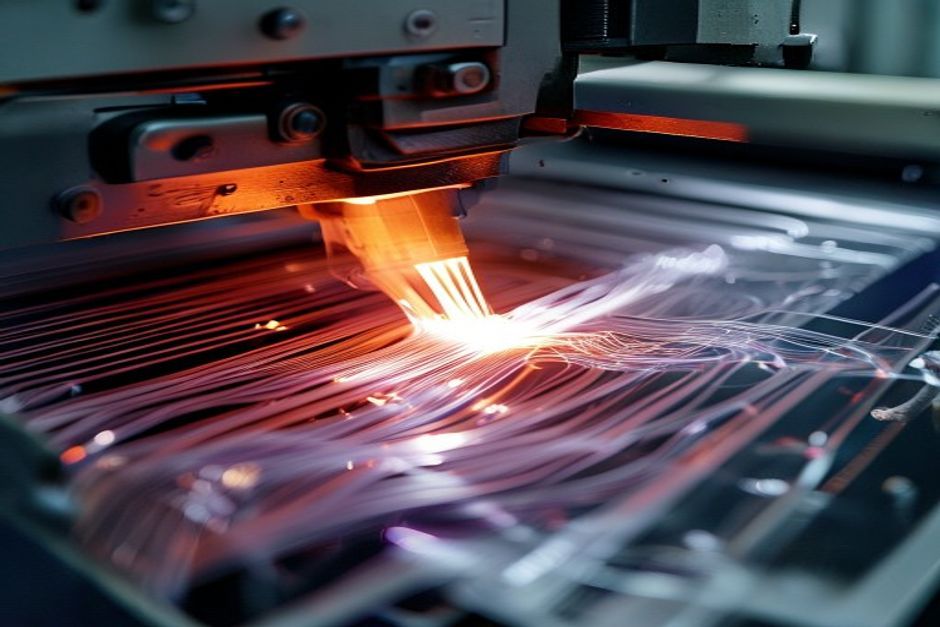
Laser cutting systems focus a high-power laser beam (CO2, fiber, or Nd:YAG) through optics and mirrors to a focal point 50-200 microns in diameter. The concentrated energy density — often exceeding 10 million watts per square centimeter — rapidly heats the material to its melting or vaporization point. A coaxial assist gas (oxygen, nitrogen, or compressed air) blows the molten material through the cut, creating a smooth kerf.
Laser Cutting Types
- CO2 Laser (10.6 µm wavelength): Best for non-metals — wood, acrylic, plastics, fabric, rubber. Also cuts thin metals but requires higher power. Widely used in fabrication shops and sign-making.
- Fiber Laser (1.06 µm wavelength): Superior for metal cutting — steel, aluminum, brass, copper. Higher wall-plug efficiency than CO2 (30% vs. 10%). Faster cutting in thin-to-medium metals. No mirrors to align; lower maintenance.
- Nd:YAG Laser: Used primarily for welding, marking, and specialized micromachining applications.
Прямое сравнение
| Фактор | Лазерная резка | Обработка с ЧПУ |
|---|---|---|
| Тип процесса | Thermal (non-contact) | Mechanical (contact) |
| Material Capability | 2D profiling primarily | Full 3D |
| Materials (Metals) | Up to 1 inch (steel), 0.5 inch (aluminum) | Unlimited thickness (multiple passes) |
| Materials (Plastics) | Cuttable but may discolor or melt | Excellent — clean cuts, no thermal effect |
| Допуски | ±0.003-0.010 inches | ±0.0005-0.002 inches |
| Ширина пропила | 0.004-0.020 inches | Tool diameter (0.031+) |
| Heat-Affected Zone | Present — 0.004-0.020 inches | Minimal (frictional heating only) |
| Эксплуатационные расходы | Low (minimal consumables) | Moderate (tooling, coolant) |

Material-Specific Considerations
Металлы
Laser cutting is the preferred process for thin-to-medium sheet metal profiling (0.020-1.0 inch steel, 0.020-0.5 inch aluminum). It is typically faster than CNC machining for 2D part profiles and produces less material waste. However, laser-cut edges have a heat-affected zone (HAZ) that may require post-processing for fatigue-critical aerospace or medical components.
Пластмассы
CNC machining is strongly preferred for engineering plastics. Laser cutting produces thermal effects in plastics — melting, discoloration, toxic fumes, and dimensional distortion — that CNC machining completely avoids. Materials like Nylon, POM (acetal), PEEK, and polycarbonate machine cleanly with appropriate feeds and speeds. For engineering plastic components requiring 3D features or tight tolerances, CNC machining is the clear choice.
Wood and Composites
Laser cutting excels for wood, plywood, and MDF — materials that would dull CNC cutting tools. The laser produces clean, dark edges with no tool marks. For carbon fiber composites, both processes can work: fiber lasers cut without delamination common in mechanical routing, but CNC routing is preferred for thick laminates (over 0.25 inches).
Choosing Between Laser Cutting and CNC Machining
- Choose Laser Cutting for: 2D sheet metal profiles, enclosures and panels, thin material with complex contours, non-metal materials (wood, acrylic, fabric), high-volume sheet metal production where speed dominates
- Choose CNC Machining for: 3D parts with pockets, holes, and stepped profiles, plastic components (no thermal degradation), tight-tolerance metallic or plastic parts (±0.001 inch), thick materials (over 1 inch in metal), threaded holes and reamed bores
- Consider Both Together: Laser cut the 2D profile from sheet stock, then CNC machine the 3D features in a subsequent operation
ЧАСТО ЗАДАВАЕМЫЕ ВОПРОСЫ
When is Laser Cutting vs CNC Machining: Complete Process Comparison the right choice?
Laser Cutting vs CNC Machining: Complete Process Comparison is the right choice when the part requires machined accuracy, controlled surfaces, repeatable features, and a material that can be cut reliably.
What should be confirmed before ordering Laser Cutting vs CNC Machining: Complete Process Comparison?
Перед началом производства подтвердите версию чертежа, марку материала, допуски, количество, критические размеры, качество обработки поверхности и требования к контролю.
What usually drives cost in Laser Cutting vs CNC Machining: Complete Process Comparison?
Стоимость обычно определяется материалом, временем наладки, машинным временем, сложностью допусков, креплением, доступом к инструменту, отделкой, контролем и количеством заказа.
How can quality risk be reduced in Laser Cutting vs CNC Machining: Complete Process Comparison?
Риск качества снижается за счет четкой маркировки критических элементов, отказа от излишне жестких допусков, раннего подтверждения технологичности и использования данных контроля важных размеров.