ПТФЭ — это актуальная инженерная тема, когда необходимо сравнить различные варианты, проверить предельные значения и выбрать технологический процесс с меньшим риском.
When printing with standard filaments like PLA or PETG, a brass nozzle performs well. However, abrasive filaments containing carbon fiber, glass fiber, or metal particles will rapidly wear through brass, causing dimensional inaccuracies and eventual print failure.
What Makes Filaments Abrasive
Carbon fiber reinforced filaments are highly abrasive with fiber hardness around 200 HB. Glass fiber is even harder at 500 HB. Metal-filled and glow-in-the-dark filaments also cause rapid wear. Our Филамент PA6-CF is optimized for reliable printing.
Nozzle Materials Compared
Brass nozzles (hardness 55-100 HB) last 10-50 hours with CF filament. Hardened steel (700-900 HB) provides 200-500 hours of use. Ruby nozzles (1500+ HB) offer unlimited wear life for production environments.
Print Settings for Hardened Nozzles
Increase temperature by 5-10°C vs brass due to lower thermal conductivity. Extrusion may need 2-5% more flow. First layer settings may require adjustment.
Source Quality Abrasive Filaments
As a specialized source manufacturer, we supply carbon fiber and glass fiber reinforced filaments with consistent diameter tolerance (±0.03mm). Свяжитесь с нами for technical support and samples.
Get a Free Quote
Fill out the form below and our engineers will respond within 24 hours.
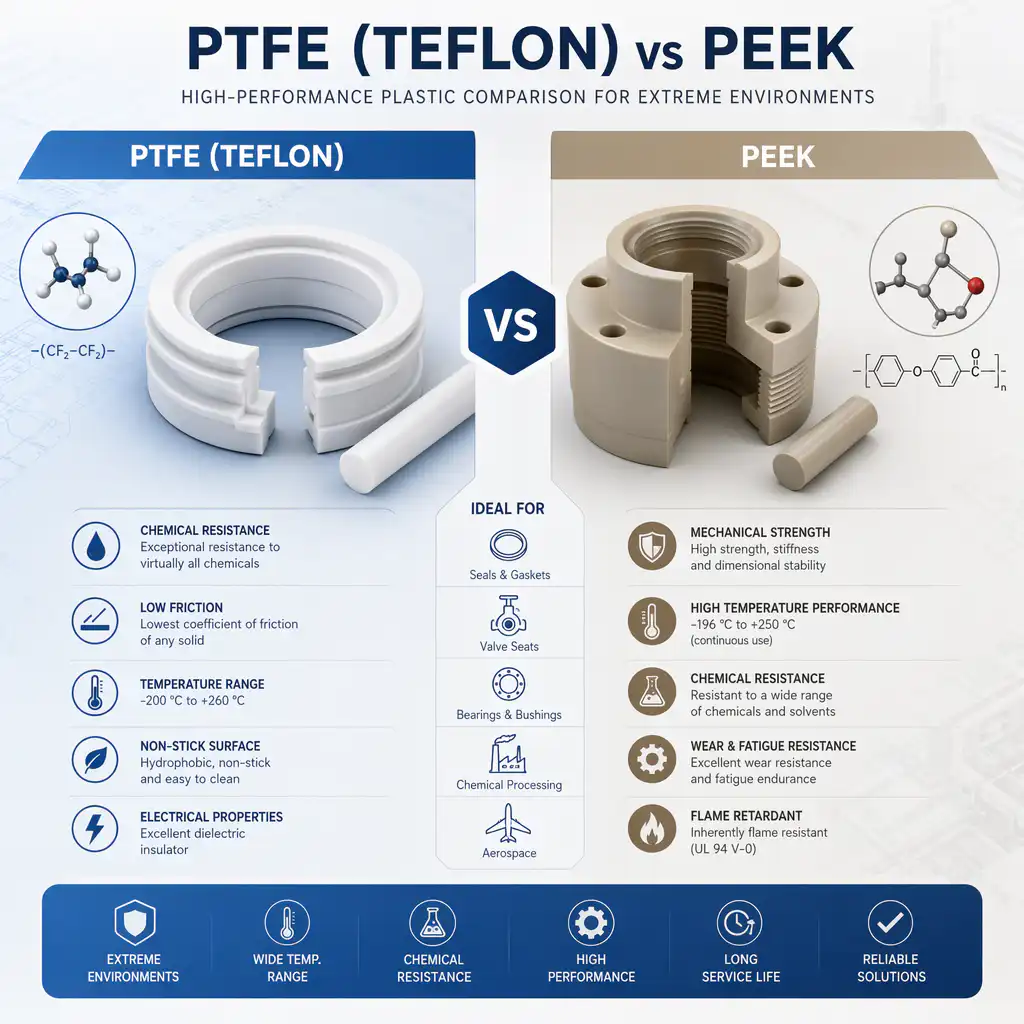
PTFE vs PEEK Material Decision Table
| Требование | ПТФЭ | PEEK |
|---|---|---|
| Friction and release | Very low friction and strong non-stick behavior | Low friction with much higher structural strength |
| Temperature and load | Excellent chemical and temperature resistance, but limited stiffness under load | High continuous-use capability with better stiffness, wear and creep resistance |
| Processing | Often machined or compression-processed; filled grades change behavior | Requires controlled high-temperature molding, machining or printing |
| Part selection | Seals, liners and low-friction interfaces | Loaded bushings, insulators and precision structural wear parts |
Choose from the completed load, temperature, friction and chemical envelope. Confirm grade, filler, surface finish and dimensional test method rather than relying on the base polymer name alone.
ЧАСТО ЗАДАВАЕМЫЕ ВОПРОСЫ
В каких случаях целесообразно проводить сравнение PTFE (тефлона) и PEEK — высокоэффективных пластиков для эксплуатации в экстремальных условиях?
PTFE (тефлон) против PEEK — сравнение высокоэффективных пластиков для экстремальных условий эксплуатации — это хороший вариант, когда быстрая итерация, сложная геометрия, низкая стоимость инструментов или мелкосерийное производство имеют большее значение, чем себестоимость одной литой детали.
Что следует учесть перед выбором между PTFE (тефлоном) и PEEK — сравнение высокоэффективных пластиков для эксплуатации в экстремальных условиях?
Проверьте размер детали, свойства материала, качество обработки поверхности, допуск на размеры, тепловое воздействие, направление нагрузки и необходимость последующей обработки.
Как соотносятся PTFE (тефлон) и PEEK — сравнение высокоэффективных пластиков для экстремальных условий эксплуатации — с точки зрения обработки на станках с ЧПУ?
3D-печать позволяет быстро создавать сложные формы, в то время как обработка на станках с ЧПУ часто более эффективна для получения точных поверхностей, более жестких допусков и материалов производственного класса.
Что влияет на стоимость ПТФЭ (тефлона) по сравнению с PEEK — сравнение высокоэффективных пластиков для эксплуатации в экстремальных условиях?
Стоимость зависит от материала, объема сборки, времени печати, высоты слоя, удаления поддержки, финишной обработки, контроля и количества деталей в сборке.

