When engineers design structural components in automotive, industrial equipment, or electrical housings, the first question is often: “Where do I find the datasheet for PA66 GF30?” And the second question usually follows within minutes: “Should I use GF50 instead?”
PA66 reinforced with 30% or 50% glass fiber represents two of the most widely specified engineering thermoplastics in the world. Both offer the heat resistance of polyamide 66 combined with the dramatic stiffness and strength improvements that glass fiber reinforcement delivers. But the numerical gap — 30% vs 50% — does not translate linearly to performance, and assuming “more glass is always better” leads to tooling surprises, warpage problems, and cost overruns.
This article consolidates the key datasheet values for PA66 GF30 and GF50 in one place, explains what each property means in practical design terms, maps out the major commercial grades from BASF, DuPont, and DSM, and gives you a clear decision framework for choosing between them.
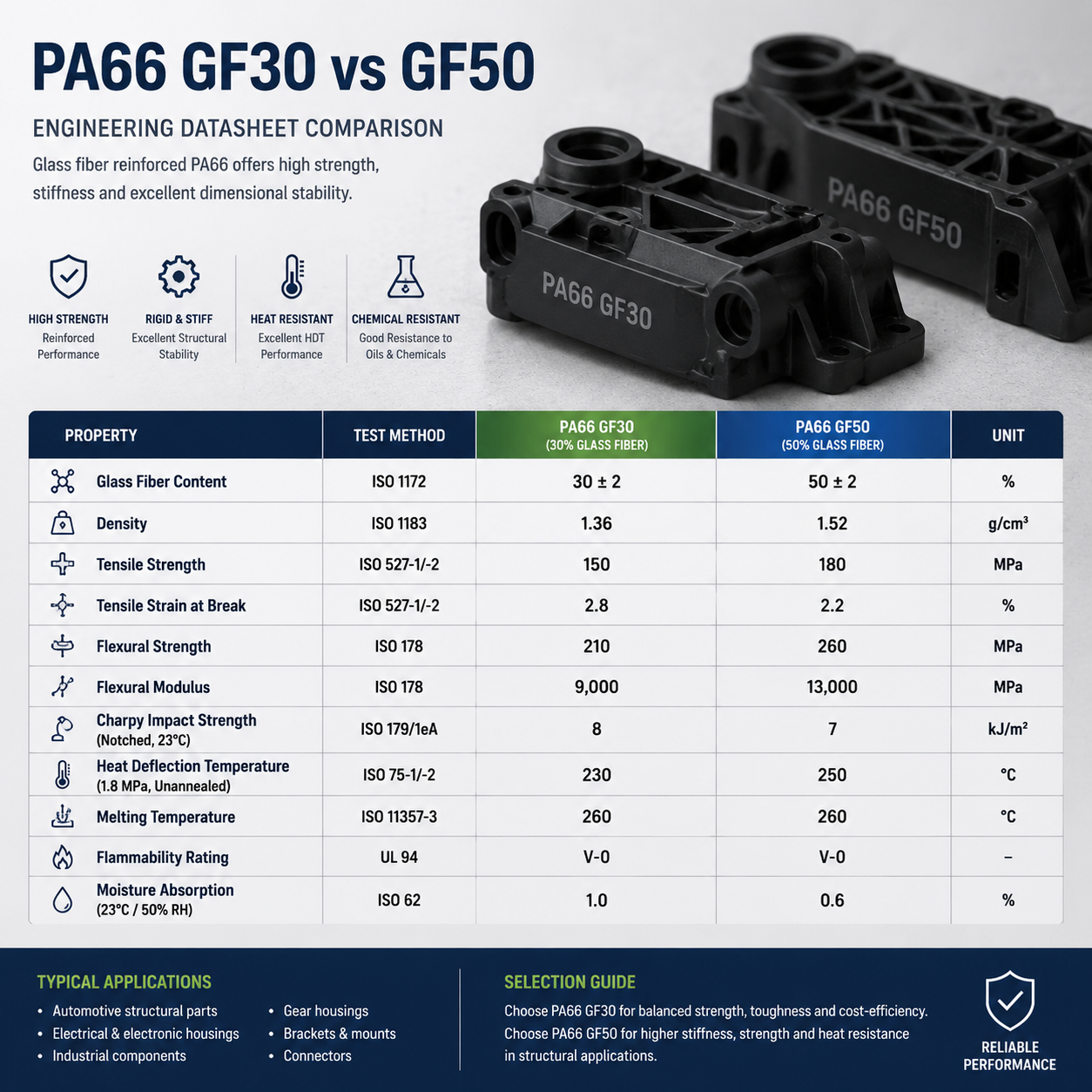
Quick Comparison Table: PA66 GF30 vs GF50 Datasheet Values
The values below represent typical injection molded specimens tested at 23°C in the dry-as-molded condition (DAM). Always consult the specific grade datasheet for your selected material, as formulation differences — heat stabilization, impact modification, lubricant packages — can shift individual properties by 5–15%.
| Недвижимость | Единица | PA66 GF30 | PA66 GF50 | Метод испытания |
|---|---|---|---|---|
| Плотность | г/см³ | 1.35 – 1.38 | 1.55 – 1.58 | ISO 1183 |
| Tensile Strength (Break) | МПа | 180 – 195 | 220 – 240 | ISO 527 |
| Модуль упругости при растяжении | МПа | 9,500 – 10,500 | 16,000 – 17,500 | ISO 527 |
| Прочность на изгиб | МПа | 270 – 290 | 340 – 370 | ISO 178 |
| Модуль упругости | МПа | 8,500 – 9,200 | 14,000 – 15,500 | ISO 178 |
| Ударная вязкость по Шарпи с надрезом (23 °C) | кДж/м² | 10 – 13 | 14 – 17 | ISO 179/1eA |
| Charpy Notched Impact (−30°C) | кДж/м² | 7 – 9 | 10 – 13 | ISO 179/1eA |
| HDT (1.8 MPa) | °C | 245 – 250 | 250 – 255 | ISO 75-2/Af |
| Melting Point (DSC) | °C | 255 – 265 | 255 – 265 | ISO 11357 |
| Mold Shrinkage (Flow) | % | 0.30 – 0.55 | 0.15 – 0.30 | ISO 294-4 |
| Mold Shrinkage (Transverse) | % | 0.60 – 0.90 | 0.35 – 0.55 | ISO 294-4 |
| Удельное сопротивление поверхности | Ω | 10¹² – 10¹³ | 10¹² – 10¹³ | IEC 60093 |
What Each Property Means in Practice
Tensile Strength and Modulus: The Core Stiffness Numbers
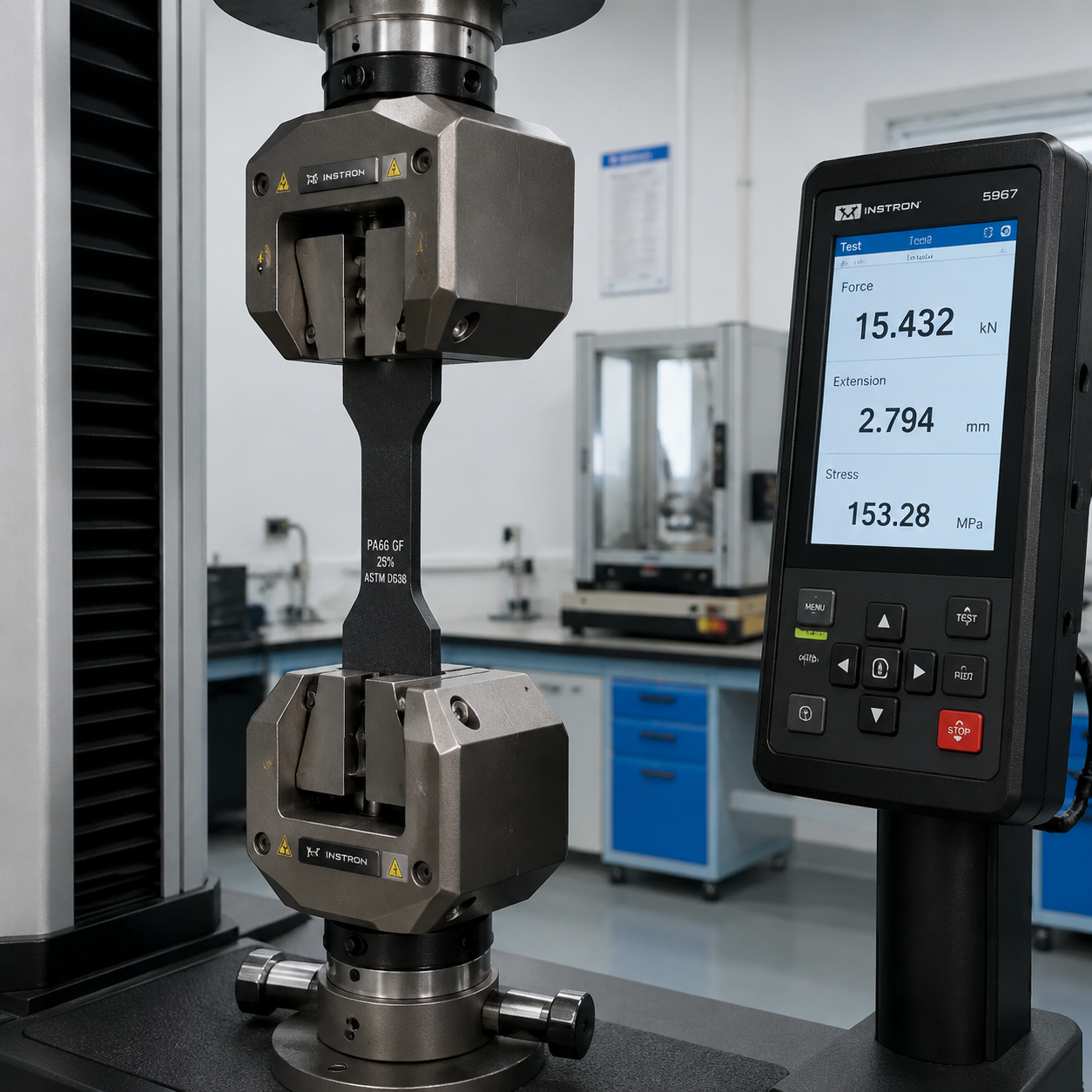
Tensile strength is the maximum stress the material can withstand while being pulled before it breaks. The jump from GF30 (approximately 185 MPa) to GF50 (approximately 230 MPa) represents a roughly 25% increase in ultimate strength. However, the tensile modulus — the material’s resistance to elastic deformation — nearly doubles. GF50 is dramatically stiffer: it stretches less under a given load. This matters for structural brackets, pump housings, and any application where deflection under load is the limiting design criterion rather than ultimate failure.
A practical consequence: if you are replacing die-cast aluminium with PA66, GF50 comes much closer to matching the stiffness of light metals. GF30 often requires ribbing or thicker wall sections to achieve equivalent structural rigidity.
HDT: Heat Deflection Under Load
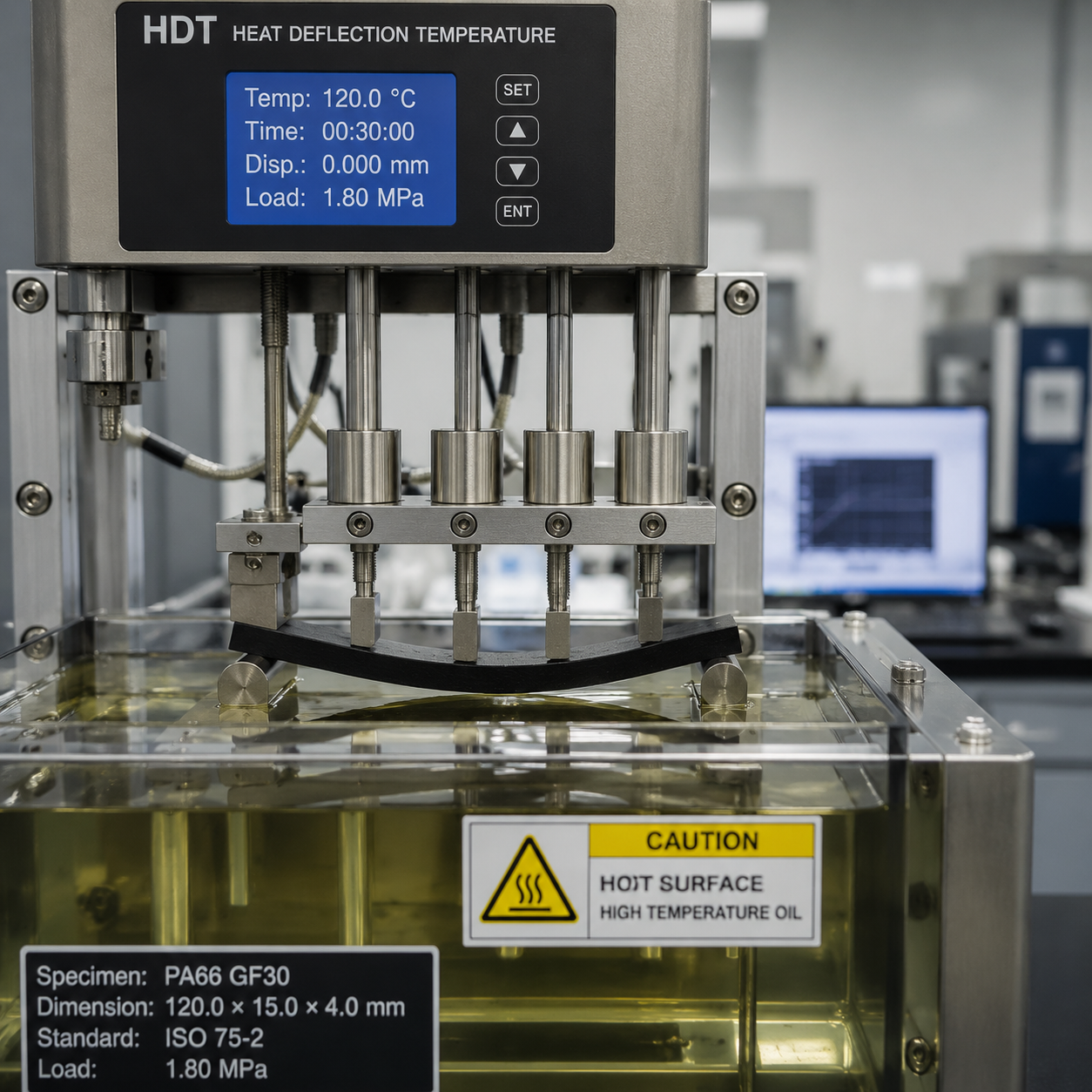
The HDT at 1.8 MPa (ISO 75-Af) for both GF30 and GF50 sits in the 245–255°C range — close to the crystalline melting point of PA66 itself. The glass fibers create a rigid skeletal network that resists deformation even as the PA66 matrix softens. The 5°C advantage GF50 holds at the upper end is real but small. In practice, both grades are rated for similar continuous-use temperature windows. The HDT value confirms that short-term exposure to 240°C+ is feasible, but above 220°C oxidative degradation of the polyamide matrix accelerates regardless of glass content.
Shrinkage and Warpage: The Hidden Differentiator
This is where the GF30 vs GF50 decision gets interesting. GF30 exhibits mold shrinkage of 0.3–0.55% in the flow direction and 0.6–0.9% transverse — a roughly 2:1 anisotropy ratio. GF50 shrinks less overall (0.15–0.3% flow, 0.35–0.55% transverse), and the anisotropy ratio tightens to approximately 1.7:1.
Lower absolute shrinkage means GF50 molds closer to nominal dimensions. But higher glass content also means higher melt viscosity, which requires higher injection pressures and can increase residual stress if the part has abrupt wall thickness transitions. For large, flat parts, GF50’s lower and more isotropic shrinkage is a genuine advantage. For thin-walled parts with long flow paths, GF30 may fill more easily and warp less in practice despite the higher datasheet shrinkage numbers.
Соображения по обработке
GF50 demands more from the molding process: higher barrel temperatures (290–310°C recommended vs 280–300°C for GF30), higher injection pressures, and faster screw wear. Standard nitrided screws will wear noticeably faster processing GF50; bimetallic screws and barrels are strongly recommended for sustained production. Gate design matters more with GF50 because the higher viscosity and fiber content increase the risk of jetting and poor knit-line strength.
Conditioned vs Dry: The Moisture Effect
Polyamide 66 absorbs moisture from the environment — typically 1.5–2.5% by weight at equilibrium in 50% RH air. This absorbed water acts as a plasticizer, reducing stiffness and strength but dramatically increasing toughness. The table below shows typical property shifts from dry-as-molded (DAM) to equilibrium at 23°C / 50% RH.
| Недвижимость | Единица | GF30 Dry | GF30 Cond. | GF50 Dry | GF50 Cond. |
|---|---|---|---|---|---|
| Прочность на разрыв | МПа | 185 | 120 | 230 | 155 |
| Модуль упругости при растяжении | МПа | 10,000 | 6,800 | 17,000 | 11,500 |
| Charpy Notched (23°C) | кДж/м² | 12 | 18 | 15 | 22 |
| Charpy Notched (−30°C) | кДж/м² | 8 | 7 | 12 | 10 |
| Модуль упругости | МПа | 9,000 | 5,800 | 15,000 | 10,000 |
Two observations stand out. First, the property loss from moisture absorption is significant for both grades — tensile strength drops roughly 35% and modulus approximately 32% whether you start at GF30 or GF50. Second, and critically, the conditioned GF50 still outperforms dry GF30 in modulus (11,500 vs 10,000 MPa) and tensile strength (155 vs 185 MPa — roughly comparable). This means that in a humid application environment, the practical stiffness advantage of GF50 over GF30 narrows but does not disappear.
Commercial Grades and Equivalents
Most PA66 GF30 and GF50 grades on the market are formulated around a standard set of reference products. If your datasheet lists one of the grades below, the properties in this guide should align closely. For cross-referencing, always verify the specific additive package — heat-stabilized (H), impact-modified, or lubricated variants shift individual values.
| Supplier | PA66 GF30 Grade | PA66 GF50 Grade |
|---|---|---|
| BASF Ultramid | A3EG6 (standard), A3EG7 (35%) | A3EG10 |
| DuPont Zytel | 70G30HSL, 70G30HSLR | 70G50HSLR |
| DSM Akulon | K224-G6, S223-G6 | K224-G10, S223-G10 |
| Radici Radilon | A RV300 | A RV500 |
| Domo Technyl | A 218 V30 | A 218 V50 |
| Ascend Vydyne | R533, R533H | R550 |
BASF’s A3EG6 (GF30) and A3EG10 (GF50) are the most commonly cross-referenced grades worldwide. DuPont’s 70G30HSLR and 70G50HSLR add heat stabilization and lubricant for reduced mold deposit. DSM’s Akulon S223 series targets injection molding with excellent surface finish; the K224 variants are formulated for higher flow. If your application requires UL certification, grades with the “H” suffix from BASF and DuPont carry UL94 HB or V-2 listings by default and V-0 with additional flame-retardant packages.
When to Choose GF50 Over GF30
The decision often comes down to three engineering scenarios where the premium for higher glass loading pays for itself:
Scenario 1: Metal replacement where stiffness is non-negotiable. When your design is drop-in replacing a die-cast aluminum or stamped steel bracket and the existing wall thickness budget is fixed, GF30 may deflect unacceptably. GF50’s modulus of 16,000–17,500 MPa gets you into the stiffness territory of magnesium alloys. The weight savings over metal remain substantial — GF50 is still roughly one-quarter the density of aluminium.
Scenario 2: High-temperature structural load at elevated humidity. Components inside engine bays, turbocharger ducting, or industrial pump housings see both heat and moisture. As shown in the conditioned properties table, GF50 retains approximately 11,500 MPa modulus at equilibrium moisture — still above dry GF30. If your FEA model uses conditioned properties and shows marginal safety factors with GF30, stepping to GF50 is the most direct fix without redesigning geometry.
Scenario 3: Tight dimensional window with low post-mold movement. Parts that must hold precision tolerances across seasonal humidity cycles benefit from GF50’s lower absolute shrinkage and reduced moisture-induced dimensional change. Automotive sensor housings, electronic connector bodies, and precision gear carriers are classic examples.
When to Stay with GF30
GF30 remains the right choice when: your mold already exists and was cut for GF30 shrinkage (retrofitting is expensive); the part has thin walls under 1.5 mm where GF50 might short-shot; you need better surface aesthetics (lower glass content gives smoother as-molded surfaces); or the cost delta matters — GF50 typically commands a 15–25% price premium per kilogram, and molded part weight is also roughly 15% higher due to density.
Часто задаваемые вопросы
В чём заключается разница между PA66 GF30 и PA6 GF30?
PA6 GF30 имеет более низкую температуру плавления (примерно 220 °C по сравнению с 260 °C у PA66) и более низкую температуру деформации при нагрузке (HDT) (обычно 200–210 °C при давлении 1,8 МПа по сравнению с 245–250 °C). Прочность на разрыв также ниже — у PA6 GF30 она обычно составляет 160–180 МПа по сравнению с 180–195 МПа у PA66 GF30. Однако PA6 GF30 проще в обработке, лучше течет в тонкостенных изделиях и имеет более привлекательный внешний вид поверхности. PA6 также поглощает влагу немного быстрее. Выбирайте PA66 GF30, когда приоритетом является термостойкость при несущей нагрузке; выбирайте PA6 GF30 для крупных деталей, имеющих эстетическое значение, или при узких технологических ограничениях.
Какая сталь для изготовления пресс-форм требуется для производства PA66 GF50?
PA66 GF50 is abrasive due to the high glass fiber content. For prototype or low-volume tools (under 50,000 shots), hardened P20 or 718 steel with nitriding is acceptable. For production volumes above 50,000 cycles, H13 or 1.2344 tool steel hardened to 48–52 HRC is recommended. Gate inserts and runner systems wear fastest; using replaceable inserts with D2 or M2 tool steel at high-wear points extends tool life. Venting depth should be limited to 0.01–0.02 mm to prevent flash with GF50’s low melt viscosity at processing temperatures.
Можно ли наносить лазерную маркировку на PA66 GF30 и GF50?
Да, но результаты значительно различаются. На натуральных (неокрашенных) марках PA66 GF можно наносить лазерную маркировку с помощью Nd:YAG-лазера или волоконного лазера, получая тёмную отметку на светлом фоне — лазер обугливает поверхность полиамида. Однако стекловолокна на поверхности рассеивают луч и снижают контраст. GF30 обеспечивает лучший контраст лазерной маркировки, чем GF50, поскольку более высокое содержание смолы на поверхности обеспечивает больше органического материала для карбонизации. Для GF50 в целях получения надёжной и высококонтрастной маркировки рекомендуется использовать лазерно-чувствительные добавки или предварительно смешанный сорт, пригодный для лазерной маркировки (доступен по запросу у большинства крупных поставщиков).
Какова максимальная температура непрерывной эксплуатации для PA66 GF30 и GF50?
There is no single number — it depends on the specific failure criterion. For mechanical load-bearing applications: approximately 120–140°C for GF30 and 130–150°C for GF50 when the load is moderate (under 30% of ultimate tensile strength). For purely thermal exposure without mechanical load: UL Relative Thermal Index (RTI) ratings are typically 130–140°C for both grades when heat-stabilized. Short-term excursions to 180–200°C are acceptable for minutes rather than hours. Above 220°C, oxidative degradation accelerates sharply and service life is measured in hours regardless of glass content. Heat-stabilized variants (suffix “H” or “HS”) extend the thermal aging resistance by 15–25°C over standard grades.