
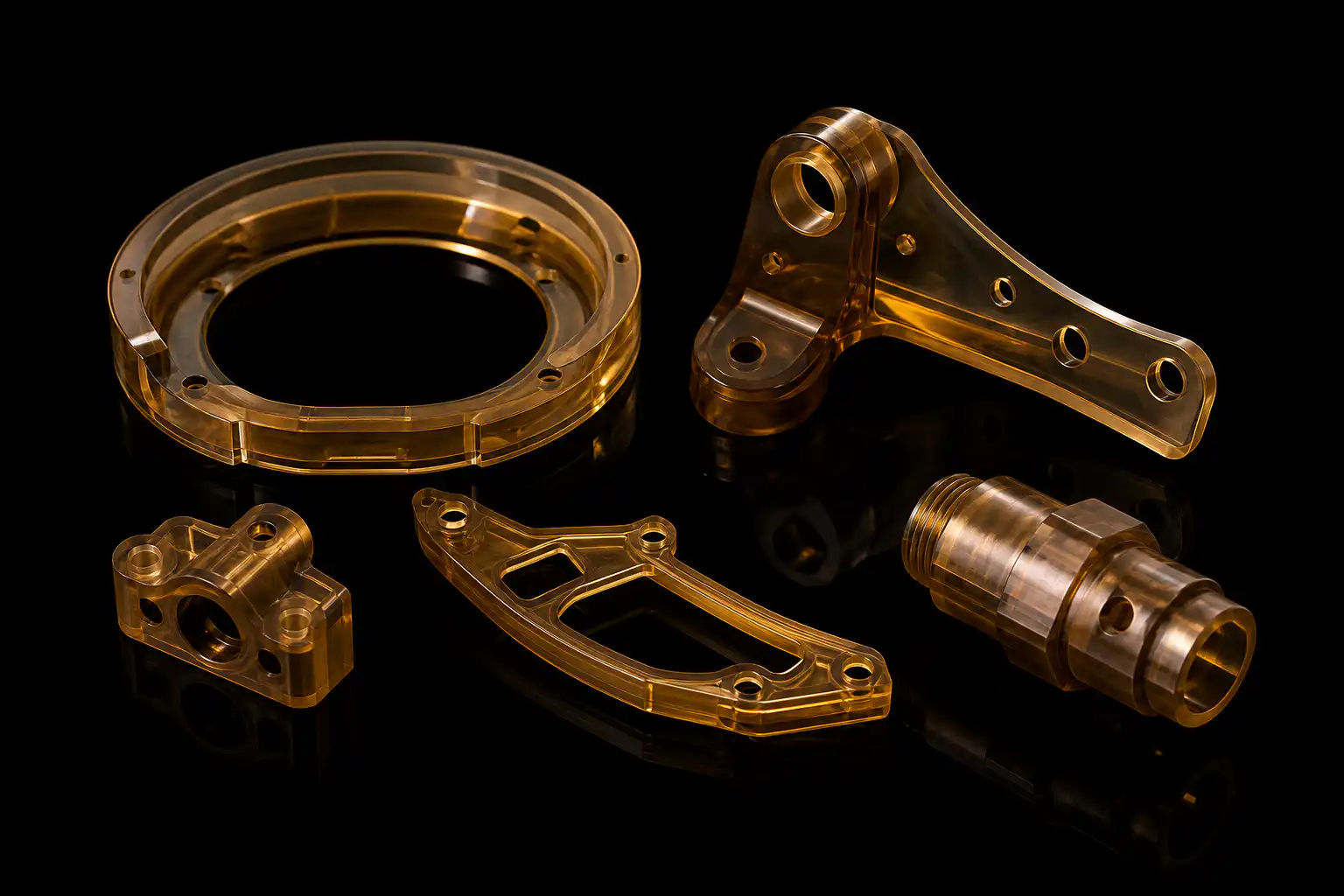
PEEK (Polyetheretherketone) sits at the absolute top of the injection moldable thermoplastic hierarchy. With a continuous service temperature of 260°C, chemical resistance that rivals fluoropolymers, and mechanical properties that compete with aluminum, PEEK is the material of choice when nothing else will work. But molding it is a different game entirely — standard injection molding equipment and parameters simply will not work. This guide covers everything you need to know about PEEK injection molding processing.
PEEK Material Overview
PEEK is a semi-crystalline aromatic polyetherketone with a unique combination of properties: glass transition temperature (Tg) of 143°C, crystalline melting point (Tm) of 343°C, and continuous service temperature of 260°C. It requires processing temperatures of 360–400°C — well beyond the capability of standard injection molding machines.
The crystallinity of PEEK is its defining processing challenge. PEEK can exist in amorphous or semi-crystalline states depending on cooling rate, and the difference in properties between the two states is dramatic: amorphous PEEK has lower chemical resistance, lower modulus above Tg, and poorer wear properties. Achieving the right crystallinity requires precise mold temperature control at 160–200°C.
| Недвижимость | Amorphous PEEK | Semi-Crystalline PEEK |
|---|---|---|
| Прочность на разрыв (МПа) | 90 | 100 |
| Modulus (GPa) | 3.6 | 4.0 |
| Химическая стойкость | Умеренный | Превосходно |
| Износостойкость | Ярмарка | Превосходно |
| Внешний вид | Transparent amber | Opaque beige/tan |
Critical Processing Parameters
Molding PEEK requires precise control across every parameter. Here is the recommended profile for unfilled PEEK (Victrex 450G or equivalent):
| Параметр | Рекомендуемое значение | Примечания |
|---|---|---|
| Barrel Rear Zone | 350°C | Feed zone — must be above Tg but below excessive degradation |
| Barrel Middle Zone | 360–370°C | Compression zone — melting and homogenization |
| Barrel Front Zone | 370–380°C | Metering zone — final temperature stabilization |
| Температура сопла | 380–390°C | Prevent cold slug and ensure smooth injection |
| Температура пресс-формы | 160–200°C | Critical for crystallinity — oil heating recommended |
| Скорость впрыска | Moderate to fast | Prevent premature freezing in thin walls |
| Поддержание давления | 70–100 MPa | Sufficient to compensate for shrinkage |
| Противодавление | Low (2–5 bar) | Excessive back pressure causes degradation |
| Скорость вращения винта | 50–100 rpm | Moderate to minimize shear heating |
| Material Drying | 150°C for 3–4 hours | Target moisture <0.02% |

Why Mold Temperature Matters Most
Mold temperature is the single most important parameter for PEEK. The mold surface temperature directly controls the cooling rate, which determines crystallinity. At mold temperatures below 150°C, PEEK cools too quickly to crystallize fully, resulting in an amorphous skin layer with poor chemical resistance. At 160–200°C, the cooling rate allows sufficient time for spherulite growth, producing semi-crystalline PEEK with optimal properties.
The mold temperature must be maintained uniformly across the entire cavity surface. Temperature variations of more than ±5°C create differential crystallinity zones, which manifest as warpage, inconsistent properties, and visible color variation (amorphous regions appear transparent amber while crystalline regions are opaque tan).
Equipment Requirements
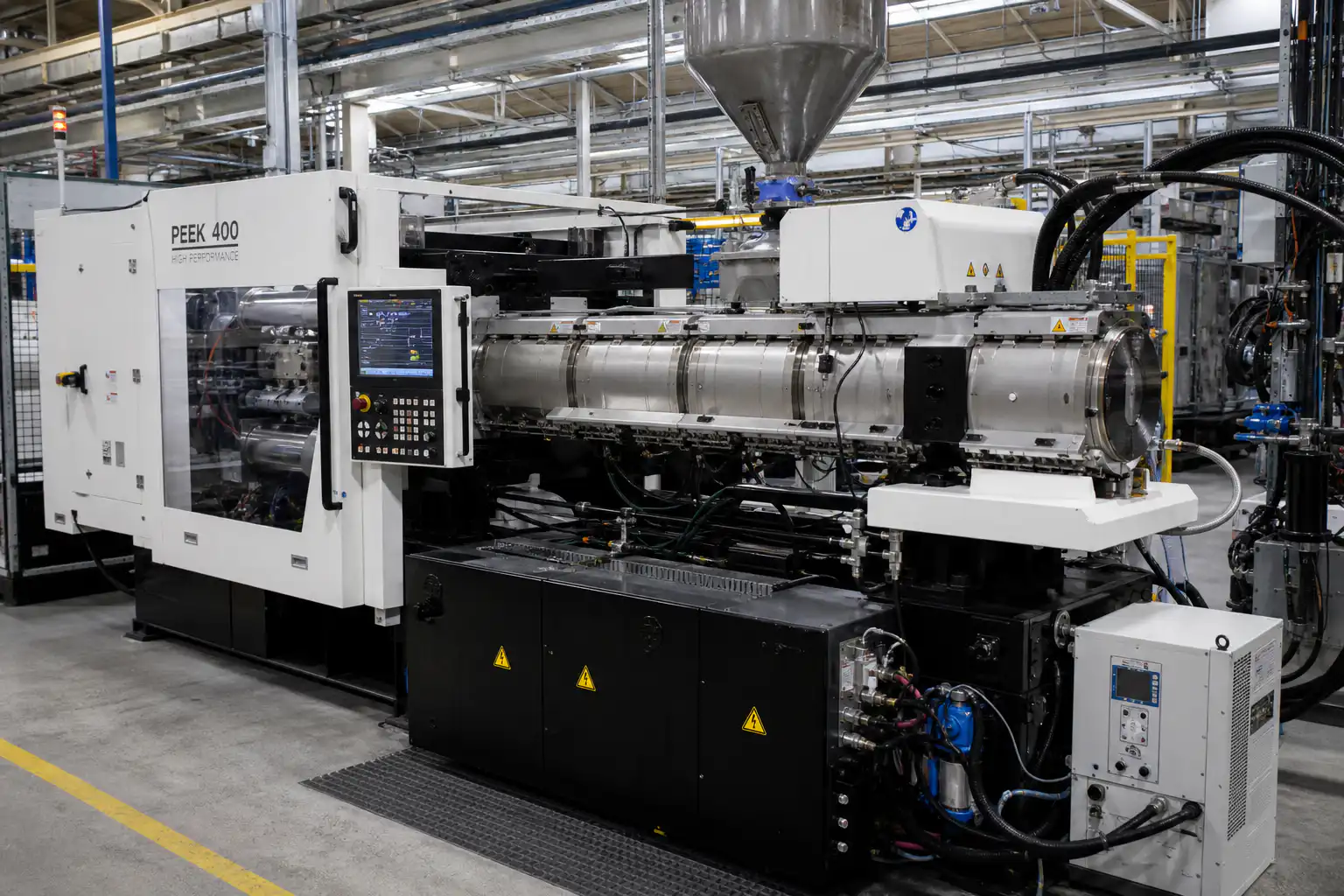
Standard injection molding machines are not suitable for PEEK. The minimum requirements are:
- Barrel and Screw: High-temperature barrel with ceramic band heaters rated for minimum 450°C continuous operation. Bimetallic screw with hardened flight tips (Colmonoy 56 or equivalent) to resist the abrasive wear of PEEK at processing temperature.
- Compression Ratio: 2.0:1 to 2.5:1 screw compression ratio. Higher compression ratios generate excessive shear heat and can cause degradation.
- Mold Heating: Oil-circulating mold temperature controllers capable of 200°C minimum. Electric cartridge heaters are an alternative but require careful multi-zone control for uniformity. Standard water-based mold temperature controllers are useless — they max out at 95–120°C.
- Insulation Plates: Thermal insulation plates (typically 10–15mm thick phenolic or ceramic composite) between the mold and machine platens are essential. Without insulation, heat from the 180°C mold conducts into the machine platens, causing thermal expansion of the tie bars and inconsistent clamp force.
- Сушка: Desiccant dryer capable of 150°C with dew point below -40°C. PEEK moisture target is <0.02% — hydrolytic degradation at processing temperature is extremely rapid if moisture is present.

Mold Design for PEEK
Gate Types: Direct sprue gates and edge gates work well. Submarine gates and tunnel gates are problematic because PEEK’s high viscosity at normal processing temperature makes it difficult to shear through small gates. Hot runner systems must be rated for 400°C and use externally heated manifolds — internally heated hot runners create cold spots.
Выпуск воздуха: Vent depth must not exceed 0.01–0.02mm (PEEK has low melt viscosity at processing temperature and will flash through larger vents). Vent land length should be 0.5–1.0mm before the vent channel opens to full depth.
Runner Sizing: Full-round runners of 6–8mm diameter are recommended. PEEK solidifies quickly, and undersized runners freeze off before packing is complete.
Draft Angles: Minimum 1° draft, preferably 2° or more. PEEK adheres strongly to mold steel at elevated temperatures, and brittle at room temperature — insufficient draft leads to ejection cracking.
Mold Steel: H13 (SKD61) hardened to 52–56 HRC. P20 is acceptable for prototype molds but will wear more quickly. Stainless steel (S136/420SS) is recommended for medical applications due to corrosion resistance during steam sterilization of the mold between runs.
Common Defects and Fixes
| Дефект | Внешний вид | Основная причина | Исправить |
|---|---|---|---|
| Black Specks | Dark spots in translucent parts | Thermal degradation in barrel | Reduce barrel temperature, residence time, or screw speed. Purge thoroughly. |
| Деформация | Part distortion after ejection | Uneven crystallinity from mold temperature variation | Improve mold temperature uniformity. Increase mold temp to 180–200°C. |
| Следы от раковины | Depressions at thick sections | Insufficient holding pressure or premature gate freeze | Increase holding pressure and time. Enlarge gate. |
| Burn Marks | Brown/black discoloration at flow end | Trapped air compression (diesel effect) | Improve venting. Reduce injection speed. |
| Incomplete Fill | Short shot, missing features | Premature solidification in thin walls | Increase injection speed and mold temperature. Add flow leaders. |

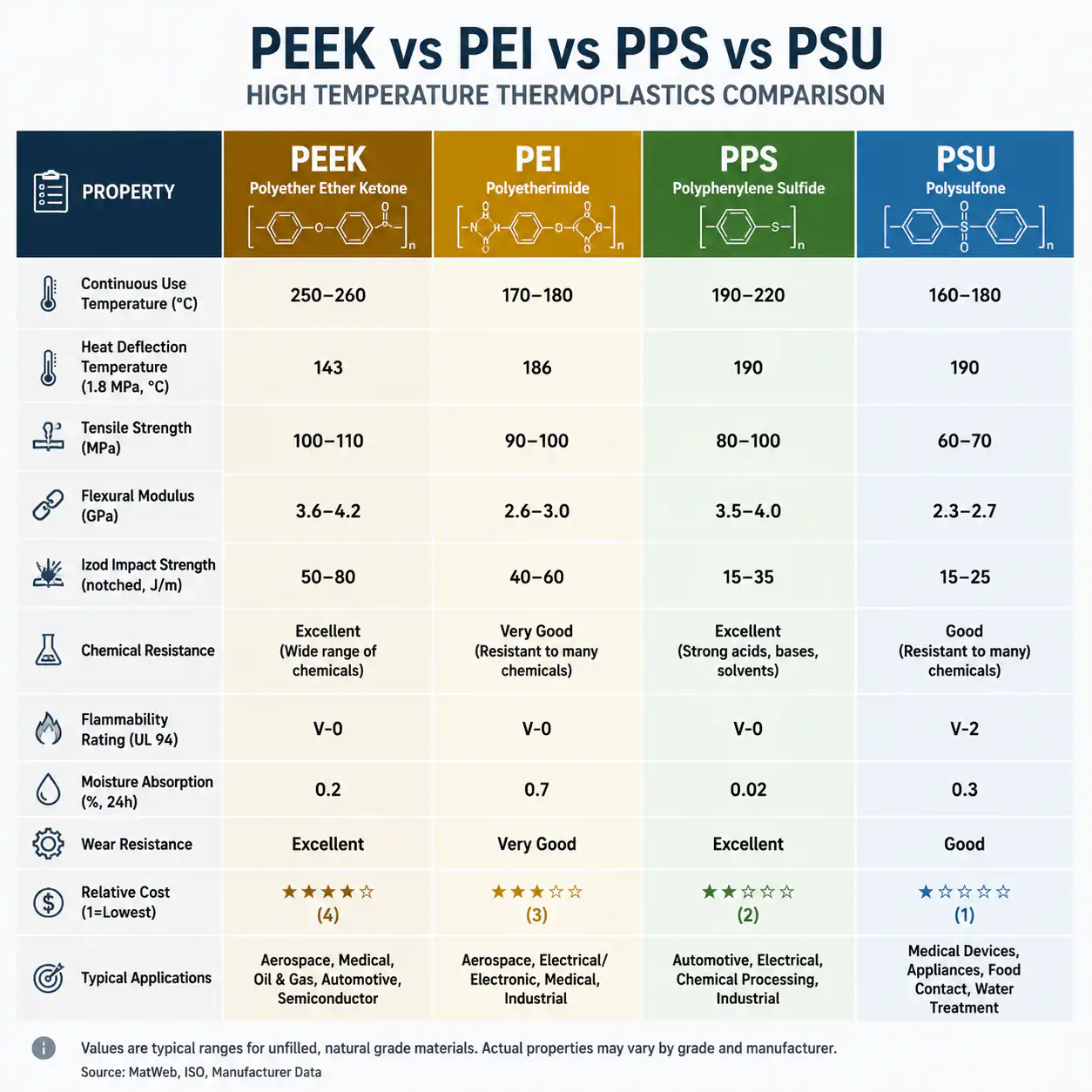
PEEK vs Other High-Temperature Thermoplastics
| Параметр | PEEK | PEI (Ultem) | PPS | PSU |
|---|---|---|---|---|
| Tg (°C) | 143 | 217 | 88 | 187 |
| Tm (°C) | 343 | Аморфный | 280 | Аморфный |
| Processing Temp (°C) | 360–400 | 350–400 | 300–340 | 330–380 |
| Температура в пресс-форме (°C) | 160–200 | 135–165 | 135–150 | 120–160 |
| Температура непрерывной эксплуатации (°C) | 260 | 170 | 220 | 160 |
| Химическая стойкость | Превосходно | Moderate — stress cracks in solvents | Превосходно | Moderate — attacks by ketones |
| Material Cost ($/kg) | 80–120 | 25–40 | 15–25 | 20–30 |
Applications for PEEK Injection Molded Parts
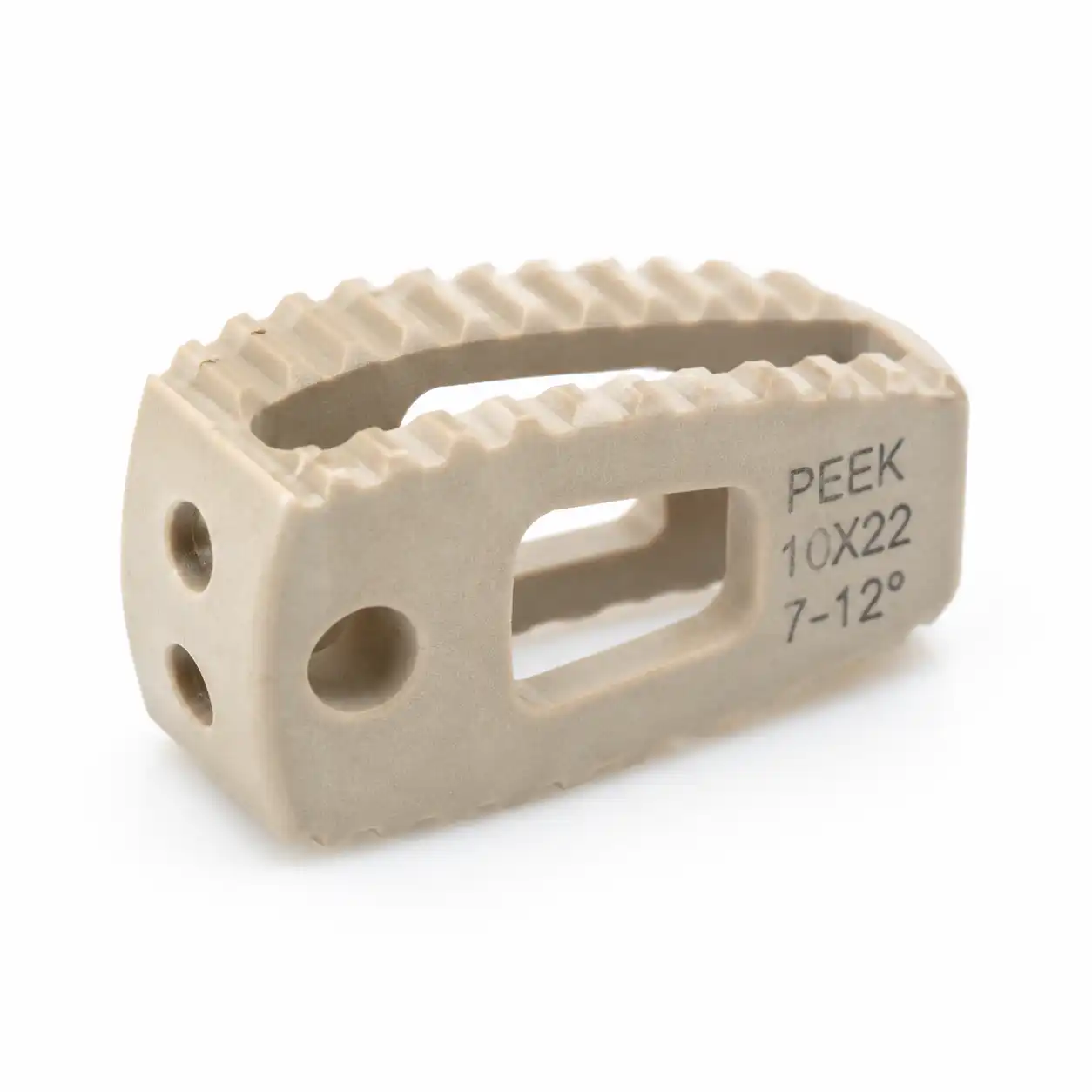
- Медицина: Spinal fusion cages, dental implants, surgical instrument handles. PEEK’s radiolucency (invisible on X-ray) and biocompatibility (ISO 10993 certified grades available) make it the dominant material for implantable devices.
- Аэрокосмическая отрасль: Brackets, bushings, seals, and wire management components. PEEK replaces aluminum in weight-critical applications, saving 70% weight with comparable mechanical performance below 260°C.
- Semiconductor: Wafer handling components, CMP rings, etch chamber fixtures. PEEK’s combination of high purity, chemical resistance, and ESD-safe grades makes it essential for semiconductor manufacturing environments.
- Oil and Gas: Seals, backup rings, valve seats. PEEK’s resistance to H₂S, CO₂, and high-pressure steam at temperatures up to 200°C is unmatched by other thermoplastics.
Cost Breakdown
PEEK parts cost 5–10 times more than equivalent PA66 parts due to three compounding factors:
- Стоимость материалов: PEEK resin at $80–120/kg vs PA66 at $3–5/kg — a 20–40× material cost multiplier.
- Mold investment: Hot-oil heated molds with H13 hardened steel cost 2–3× more than standard P20 water-cooled molds.
- Cycle time: PEEK cooling in a 180°C mold takes significantly longer than nylon cooling in a 60°C mold. Cycle times of 60–120 seconds are typical for PEEK parts weighing 20–50g, compared to 15–30 seconds for equivalent nylon parts.

Заключение
PEEK injection molding is a specialized discipline that requires investment in high-temperature equipment and deep processing expertise. It is not a material you can run on a standard molding machine with a few parameter tweaks. But for applications that demand the highest combination of temperature resistance, chemical resistance, and mechanical properties available in a thermoplastic, PEEK is simply unmatched. The key to success is treating mold temperature control as your primary quality parameter, investing in proper drying, and working with a molder who has verified PEEK processing capability — not just a claim on a website.
Часто задаваемые вопросы
Можно ли формовать PEEK на стандартном литьевом прессе?
Нет. Стандартные машины, как правило, имеют ограничения по температуре цилиндра в диапазоне 300–350 °C и используют формы с водяным охлаждением, максимальная температура которых составляет 95 °C. Для литья PEEK требуется температура цилиндра 360–400 °C и температура формы 160–200 °C. Как минимум, машина должна быть оснащена керамическими ленточными нагревателями, рассчитанными на 450 °C, биметаллическим шнеком и регулятором температуры формы с масляной циркуляцией. Модернизация стандартной машины возможна, но зачастую обходится дороже, чем сама машина.
Какова минимальная температура формы для PEEK?
Практический минимум для PEEK без наполнителя составляет 160 °C. При температуре ниже этого значения скорость охлаждения слишком высока для полного развития кристалличности, что приводит к образованию аморфной структуры с низкой химической стойкостью и ухудшенными механическими свойствами при температурах выше Tg. Для тонкостенных деталей (толщиной менее 1 мм) минимальная температура повышается до 180 °C, чтобы предотвратить преждевременное затвердевание. Для PEEK, армированного углеродным волокном, рекомендуется температура 180–200 °C.
Как предотвратить деградацию PEEK во время литья?
Предотвращение деградации зависит от четырёх факторов: (1) Высушить материал до влажности ниже 0,02% (150 °C, 3–4 часа в осушительной сушилке). (2) Свести к минимуму время пребывания — не превышать 5 минут при 380 °C. (3) Использовать низкое противодавление (2–5 бар) для снижения нагрева от сдвига. (4) Между циклами литья PEEK продувайте цилиндр с помощью высокотемпературного продувочного состава или термостабильного полимера (например, PPS). Черные вкрапления являются первым видимым признаком деградации — если вы их заметили, немедленно снизьте температуру и время пребывания.
Является ли литье PEEK дороже, чем механическая обработка PEEK на станках с ЧПУ?
При объемах производства свыше 500–1 000 деталей в год литье под давлением, как правило, является более экономически выгодным, чем обработка на станках с ЧПУ из заготовок из PEEK. Инвестиции в форму для литья под давлением ($20 000–$80 000 за форму, пригодную для PEEK) амортизируются за счёт объёма производства, в то время как затраты на обработку на станках с ЧПУ остаются линейными. Однако для изготовления прототипов и партий объемом менее 500 деталей обработка на станках с ЧПУ из стержней или пластин из PEEK почти всегда обходится дешевле. Многие программы начинаются с изготовления прототипов на станках с ЧПУ, а затем переходят к литью под давлением для серийного производства.

